ηDragonfly
 Dragonfly Aerospace
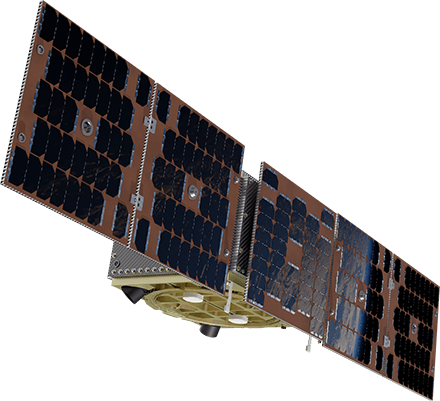
A 50 kg nano-class satellite bus combining microsatellite-grade performance and reliability in a compact cubesat-class form factor, designed for sensitive imaging payloads with a 5+ year operational life.
Typed specifications34 values
Discloses 4 of 7 fields engineers filter by in this category (category median 3).
- Mass
- 50 kg nom. · printed as Class '50 kg bus — 15” port'; dry/wet not stated · datasheet p.1
- Power consumption
- 1 200 W product page 113–197 W | 71–125 W
- Data interface
- LVDS Data: LVDS / SpaceWire / SerDes · datasheet p.1 other Data: SerDes | CAN TMTC: CANBus | Ethernet TMTC: GigE | RS-422 TMTC: RS422/RS485 +2
- Design lifetime
- 5 years datasheet p.1
- Max payload mass
- 50 kg max · Available Mass, 'Up to 50 kg' · datasheet p.1
- Payload envelope (L × W × H)
- 450 x 450 x 400 Available Volume · datasheet p.1
- Power available to payload
- 20 W max · orbit average (Available OAP, 'Up to 20 W') · datasheet p.1
- Unregulated bus for the payload
- 24.3–32.4 V Bus Voltage 24.3-32.4 V (unregulated) · datasheet p.1
- Onboard storage for payload data
- 1 024 GB Optional High Speed Data Recorder (HSDR) · datasheet p.1
- Power generation (orbit average)
- 71–125 W Orbit Average Power (OAP) 71-125 W · datasheet p.1 113–197 W peak (Solar Array Peak Power 113-197 W)
- Battery capacity
- 300 Wh max · Energy storage, 'Up to 300 Wh' · datasheet p.1
- Pointing accuracy
- 0.01 ° max · Pointing Control Accuracy, 3-sigma · datasheet p.1
- Propulsion
- included Xenon Electric Propulsion System, 11 mN thrust, up to 1400 s Isp · datasheet p.1
- Payload data downlink rate
- 400 kbps S-band TMTC downlink (uplink 150 kbps) · datasheet p.1 2 600 000 kbps X-band data downlink, peak
- Radio band
- S S-Band TMTC · datasheet p.1 X X-Band Data Downlink
- Subsystems included
- ADCS Attitude and Orbit Control (fully automated AOCS) · datasheet p.1 EPS Electrical Power System | battery Energy storage up to 300 Wh | S-band radio S-Band TMTC | solar arrays Solar Array Peak Power 113-197 W +2
- Separation interface diameter
- 381 mm datasheet p.1
Each value is typed with its unit and measurement condition and cites the datasheet page it was taken from. Nothing is guessed: a field that is absent here has not been published by the manufacturer. machine-extracted ✓ checked by NewSpace Market ✓ manufacturer confirmed by the manufacturer.
As published by the supplier19 lines, in the manufacturer's own wording
- Pointing control stability
- <0.005°/sec (3-sigma)
- Pointing control accuracy
- <0.01° (3-sigma)
- Slew rate
- Up to 12°/sec
- Geolocation knowledge accuracy
- 120 m (3-sigma)
- Control frequency
- 10 Hz
- Fully automated AOCS
- Through target tracking
- Xenon electric propulsion system
- 11 mN thrust, up to 1400s lsp
- S-band tmtc
- 400 kbps down, 150 kbps up
- X-band data downlink
- 2.6 Gbps (Peak)
- Solar array peak power
- 113-197 W
- Orbit average power (OAP)
- 71-125 W
- Peak power
- 1.2 kW
- Supply voltage
- 24.3-32.4 V (unregulated)
- Available mass
- Up to 50 kg
- Available volume
- 450 × 450 × 400 mm
- Available oap
- 20-70 W
- Tmtc
- CANBus, RS422/RS485, GigE
- Data
- LVDS / SpaceWire / SerDes
- Optional high speed data recorder (HSDR)
- 1 TB
About
The ηDragonfly is a nano-class satellite bus that revolutionises space delivery with the capability to deploy multiple satellites in a single launch. It combines microsatellite performance and reliability within compact cubesat-class parameters, eliminating the need for additional launcher pods. Weighing just 50 kg, the ηDragonfly is engineered to deliver five years or more of in-orbit operation and is designed for sensitive imaging payloads. It leverages validated avionics components from the successful EOS SAT-1 satellite mission launched in January 2023, ensuring top-tier performance and reliability. The bus features a fully automated AOCS (attitude and orbit control system) capable of target tracking, with high pointing control stability (<0.005°/sec, 3-sigma) and pointing accuracy (<0.01°, 3-sigma), a slew rate of up to 12°/sec, geolocation knowledge accuracy of 120 m (3-sigma), and a 10 Hz control frequency. Propulsion is provided by a xenon electric propulsion system delivering 11 mN thrust at up to 1400 s specific impulse. Communications include S-band TMTC (400 kbps downlink, 150 kbps uplink) and X-band data downlink at up to 2.6 Gbps peak. The power system provides 113-197 W solar array peak power, 71-125 W orbit average power (OAP), and up to 1.2 kW peak power, on an unregulated bus voltage of 24.3-32.4 V, with up to 20-70 W OAP available for payloads. Available mass for payloads is up to 50 kg within an available volume of 450 × 450 × 400 mm. TMTC interfaces include CANBus, RS422/RS485, and GigE, while data interfaces include LVDS, SpaceWire, and SerDes. An optional High Speed Data Recorder (HSDR) with 1 TB capacity is available.
Documentation
Need the full ICD, test reports or a specific revision? Ask the supplier directly.