NanoMind Z7000
 GomSpace
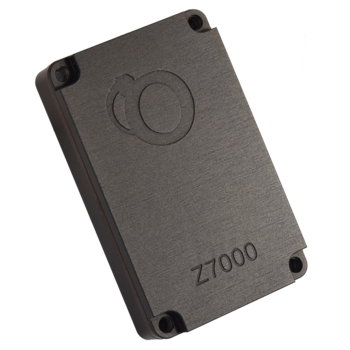
The NanoMind Z7000 is a powerful ARM/FPGA onboard computer designed for space applications, featuring a dual ARM core running Linux and a flexible FPGA for payload data processing.
Typed specifications54 values
Discloses 8 of 13 fields engineers filter by in this category (category median 5).
- Processor
- Xilinx Zynq 7030 Programmable SoC Dual ARM Cortex A9 MPCore datasheet p.4
- Mass
- 28.7 g mass of PCB · datasheet p.8 76.8 g mass total PCB + shield | 28.7 g PCB | 76.8 g total PCB + shield
- CPU clock
- 800 MHz max · datasheet p.4 800 MHz max · up to 800 MHz
- Envelope (L×W×H)
- 65 x 40 x 6.5 mm datasheet p.8
- RAM
- 1 024 MB datasheet p.4 1 024 MB DDR3 RAM
- Mass storage
- 32 GB datasheet p.4 32 GB storage (eMMC)
- Operating system
- Linux datasheet p.4 Linux default Linux installed
- Supply voltage
- 3.3 V nom. · VCC supply voltage, typical · datasheet p.8 3 V min | 3.6 V max | 3–3.6 V VCC supply voltage, electrical characteristics | 3 V min +1
- Power consumption
- 2.3 W Pmax, max power consumption, typical values with standard sof… · datasheet p.8 2.3 W max
- Data interface
- I2C datasheet p.5 SPI 26 3.3 V I/O on connectors for SPIO, I2C SPI, SD, UART etc | CAN CAN-bus / CSP CFP protocol | RS-422 KISS protocol available on the motherboard RS-422 connector | UART KISS protocol on RS-422 and UART connector (TTL level) +9
- Operating temperature
- -40 °C min · datasheet p.4 85 °C max | -40–85 °C operational temperature
- Processor architecture
- ARM Cortex-A Dual ARM Cortex A9 MPCore · datasheet p.4
- Flight software support
- CubeSat Space Protocol (CSP) over CAN-bus (CFP), I2C and KISS; Board Support Package and Linux SDK (FSBL, u-boot, Linux, build environment, FPGA-code, PARAM, LOG, GOSH, CSP, UTIL, FTP) datasheet p.9 KISS
- Connector
- 2x 100 pin Samtec datasheet p.7 1x Samtec LSHM-130-04.0-L-DV-A-S-K-TR
- Flight heritage
- flight proven datasheet p.4 in space
- Cores
- 2 Dual ARM Cortex A9 MPCore · datasheet p.4
- FPGA
- Xilinx Zynq 7030 FPGA, 125K logic cells datasheet p.4 Powerful FPGA module – 125K logic cells
- RAM type
- DDR3 datasheet p.4
- Data interface speed
- 25 Mbps max · eMMC sequential read · datasheet p.8 400 Mbps max · NOR flash performance (bootable) | 25 Mbps max · SD interface performance | 480 Mbps max · USB interface performance (used for debugging)
Each value is typed with its unit and measurement condition and cites the datasheet page it was taken from. Nothing is guessed: a field that is absent here has not been published by the manufacturer. machine-extracted ✓ checked by NewSpace Market ✓ manufacturer confirmed by the manufacturer.
As published by the supplier15 lines, in the manufacturer's own wording
- Processor
- Dual ARM Cortex A9 MPCore up to 800 MHz
- FPGA
- 125k logic cells
- RAM
- 1 GB DDR3
- Storage
- 32 GB
- Operating System
- Linux
- Dimensions
- 65 mm x 40 mm x 6.5 mm
- Operating temperature
- -40…+85 °C
- Supply voltage
- 3.0…3.6 V
- Power
- 2.3 W
- NOR flash performance (bootable)
- 400 Mb/s
- eMMC sequential Read
- 25 MB/s
- SD interface performance
- 25 MB/s
- USB interface performance
- 480 Mb/s
- DDR LVDS Transceivers
- 1250 MT/s
- Mass
- 76.8 g
About
The NanoMind Z7000 is a powerful onboard computer featuring a dual ARM core that runs the Linux operating system, offering flexibility through its 125k gate FPGA. It is perfectly suited for on-board payload data processing and is flight-proven. The computer utilizes a Xilinx Zynq 7030 Programmable SoC with a Dual ARM Cortex A9 MPCore up to 800 MHz, 1 GB DDR3 RAM, and 32 GB of storage. Its powerful FPGA module contains 125k logic cells. For integration, it requires a NanoDock SDR for a PC104 type stack and supports SPI, I2C, UART, and CAN data interfaces, along with 75 LVDS pairs or 150 CMOS. Mechanically, it features a precision milled anodized aluminum heat sink for thermal control and EMI shielding, with dimensions of 65 mm x 40 mm x 6.5 mm. Please note that this product has been phased out and is no longer available for sale.
Documentation
Need the full ICD, test reports or a specific revision? Ask the supplier directly.