Space PFO
 XCAM
XCAM
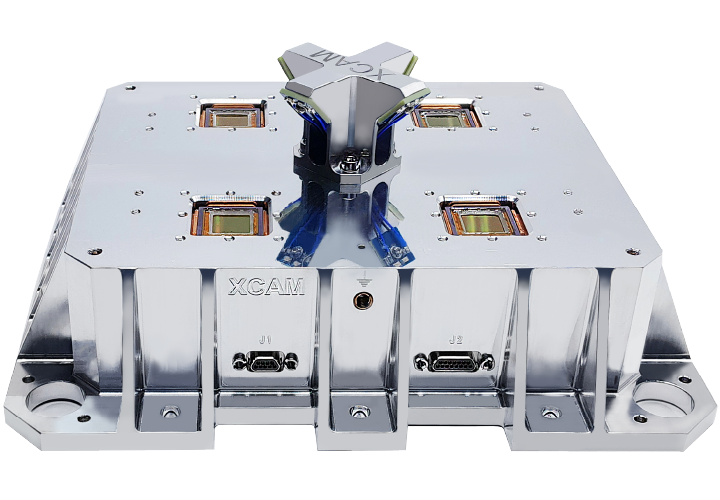
ESA-funded autonomous particulate contamination monitor for space launch vehicle fairings, detecting particles from 5 um during ascent.
Key figurescomparable across the catalogue
- Mass
- 2.5 kg
Normalised to common units so this product can be compared with others in its category. The supplier's own wording is below.
As published by the supplier
- Total detection area
- 4 cm2
- Sample rate
- Every 10 seconds (minimum)
- Minimum detectable particle size
- 5 um (100% detection)
- Maximum detectable particle size
- >750 um
- Data acquisition lifetime
- >=254 seconds
- Post-flight data transfer lifetime
- >=5 hours
- Operating temperature
- -20 to +80 deg C
- Operational humidity
- 0 to 95% RH
- Volume
- ~2.4 litres
- Mass
- 2.5 kg
- Particle classification
- Size, shape, distribution; particle/fibre
About
The Space PFO is a particulate contamination monitor engineered for space launch applications, developed through a technology programme funded by the European Space Agency (ESA). It measures particle fallout (surface deposition) inside launch vehicle fairings during liftoff and ascent, providing unique in-situ contamination data to help protect sensitive spacecraft payloads.
The system operates autonomously without requiring telecommands from the launch vehicle or ground station. Upon power application it executes a pre-programmed sequence, then uses onboard environmental sensors to detect launch commencement and switch to flight data acquisition mode. Data is acquired continuously between launch and fairing ejection, after which the unit enters post-flight transmission mode for downlink of the collected particle data.
XCAM Scientific’s Direct Particle Detection (DPD) technology directly images particles settling on a silicon CMOS sensor using built-in illumination, with onboard algorithms analysing particle size, shape, and distribution in real time at a sample rate of at least every 10 seconds. The instrument detects particles from 5 um upwards and has an operational lifetime of at least 254 seconds of data acquisition.
Documentation
No public datasheet yet — request the datasheet / ICD from the supplier.