Sirius QuadCore
 AAC Clyde Space
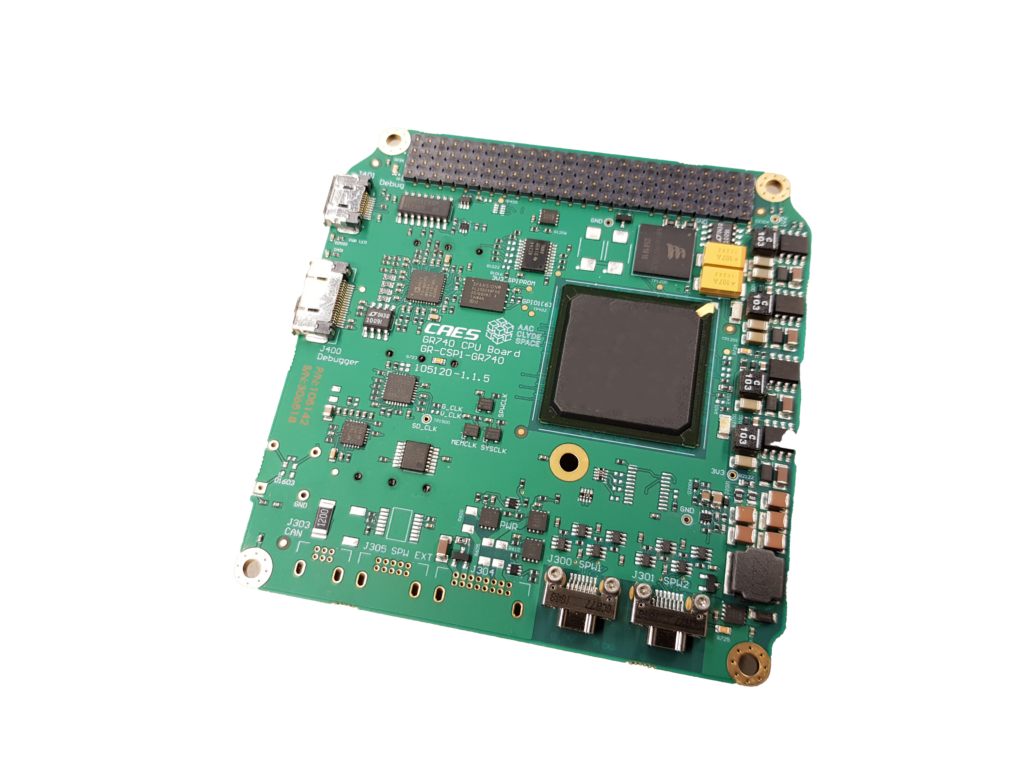
Sirius QuadCore is a next-generation, fault-tolerant Command and Data Handling solution combining an on-board computer, quad-core processing, and mass memory for New Space nanosatellite missions in LEO and deep space.
Typed specifications50 values
Discloses 11 of 13 fields engineers filter by in this category (category median 5).
- Processor
- LEON4 quad core fault-tolerant processor datasheet p.2
- Mass
- 100 g nom. · (PCBA) · datasheet p.2 100 g ~ | 100 g ~, PCBA
- CPU clock
- 250 MHz datasheet p.2 250 MHz max · per core
- Envelope (L×W×H)
- 100 x 100 x 15 mm datasheet p.3
- RAM
- 4 096 MB datasheet p.3 4 096 MB SDRAM data, plus 2Gbit EDAC
- Mass storage
- 0.002 GB datasheet p.3 0.25 GB
- Operating system
- Linux datasheet p.2 Linux LEON Linux 4.9 | RTEMS RTEMS 5 | RTEMS
- Supply voltage
- 5 V min · datasheet p.2 12 V max | 5–12 V
- Power consumption
- 4 W nom. · normal power consumption · datasheet p.2 4 W Normal Power Consumption
- Data interface
- SpaceWire datasheet p.3 RS-422 1x UART serial comm (RS422) | SPI 1x, plus internal/ext comm SPI (SPI flash, ADC) | UART 1x, serial comm (RS422) | CAN 2x, CAN 2.0b +6
- Operating temperature
- -30–60 °C datasheet p.3
- Radiation tolerance (TID)
- 20 krad datasheet p.3 30 krad min · qualified >30 kRAD, Si
- Design lifetime
- 5–7 years datasheet p.3 5–7 years in LEO
- TRL
- 8 product page
- Processor architecture
- LEON / SPARC LEON4, IEEE-1754 SPARC v8 · datasheet p.2
- Radiation and fault mitigation
- TMR in FPGA datasheet p.1 EDAC / ECC on RAM EDAC on memories | other TMR (Triple-Modular Redundancy) on boot flash | EDAC / ECC on RAM
- Satellite class
- nanosat 1-10 kg New Space nanosatellite missions · datasheet p.1
- Cores
- 4 datasheet p.2
- GPIO lines
- 9 3V LVTTL · datasheet p.2
- RAM type
- SDRAM datasheet p.2
- Program / boot memory
- 2 MB MRAM (bootflash), boot memory · datasheet p.2 256 MB SPI-Flash, image memory
- Redundancy
- single string standard single string system · datasheet p.1
- Data interface speed
- 300 Mbps max · SpaceWire · datasheet p.2
Each value is typed with its unit and measurement condition and cites the datasheet page it was taken from. Nothing is guessed: a field that is absent here has not been published by the manufacturer. machine-extracted ✓ checked by NewSpace Market ✓ manufacturer confirmed by the manufacturer.
As published by the supplier8 lines, in the manufacturer's own wording
- TRL
- 8
- Processor
- LEON4FT, 250 MHz LEON4 quad core fault-tolerant processor
- Operating system
- Linux or RTEMS real-time operating system compliant to IEEE 1754 SPARCv8
- Fault tolerance
- TMR (Triple-Modular Redundancy) on boot flash and EDAC (Error Detection and Correction) on memories
- SEE tolerance
- Tolerant to Single-Event-Effects (SEE) in logic and data storage
- Design life
- Designed and qualified for five years in LEO
- Communication interfaces
- CAN bus for low level commanding and monitoring, SpaceWire router for fast communication between subsystems/payloads
- System architecture
- Standard single string system combining Sirius OBC (on-board computer), quad core computing, and combined mass memory with CCSDS stack (Sirius TCM)
About
Sirius QuadCore is AAC Clyde Space’s next-generation Sirius Command and Data Handling solution, engineered for high performance data processing for New Space nanosatellite missions. It runs mission specific software and can manage both the spacecraft system and payload computing processing, designed for advanced satellite constellations in LEO and deep space exploration missions. It utilises a powerful LEON4FT processor to deliver ‘always on’ reliable operations with precision performance. It surpasses its predecessor in processing capability and comes with inbuilt protections based on over a decade of error correction design heritage to guarantee realtime-on-time operations. With enhanced error detection and correction, the Sirius QuadCore is tolerant to Single-Event-Effects (SEE) in logic and data storage. Fault tolerance is secured through TMR (Triple-Modular Redundancy) on boot flash and EDAC (Error Detection and Correction) on memories, making it one of the most reliable C&DH solutions available on the market. It features multi-core processing capability and low power consumption. It has a standard single string system, combining the flight-proven Sirius OBC on-board computer, quad core computing, and a combined mass memory with CCSDS stack (Sirius TCM). The TCM receives and stores payload data and platform housekeeping data, and can simultaneously distribute telecommands and serve mass memory and real time data to the transceiver. Sirius spacecraft avionics are modular in design, with modules that can be combined to offer new configurations or accommodate mission specific requirements. Performance: utilises a 250 MHz LEON4 quad core fault-tolerant processor, which can run Linux or RTEMS real-time operating system compliant to IEEE 1754 SPARCv8. Reliability: fault tolerance for uninterrupted software execution in the presence of eventual errors, designed and qualified for five years in LEO. Modularity: adopts a modular design approach enabling easy system integration, utilising CAN bus for low level commanding and monitoring, and a SpaceWire router for fast communication between subsystems/payloads. TRL 8.
Documentation
Need the full ICD, test reports or a specific revision? Ask the supplier directly.