PCM Bit Synchronizers
 GDP Space Systems
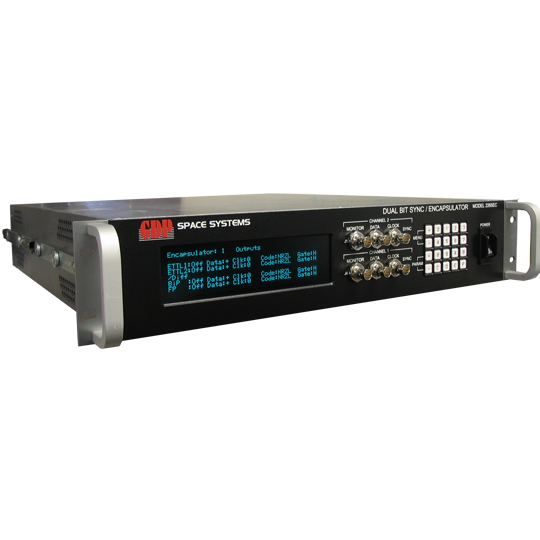
GDP Space offers a range of PCM Bit Synchronizers designed to reconstruct input data streams and recover the clock with high fidelity for telemetry ground stations, ensuring reliable data processing even in challenging signal conditions.
Key figurescomparable across the catalogue
- Data rate
- 40 Mbps
Normalised to common units so this product can be compared with others in its category. The supplier's own wording is below.
As published by the supplier
- Performance
- Better than 1 dB from theory all the way down to –3 dB Eb/No
- Input signal levels
- Down to 100 mV
- Data rates
- 10 bps to 40+ Mbps
- Model 2265 channels
- Up to 4 bit synchronizer channels
- Model 2265 chassis
- 2U
- Model 2265 synchronization
- Down to –3 dB Eb/No at signal levels down to 100mVpp
- Model 2365a channels
- Up to 8 channels
- Model 2365a chassis
- 4U
- Model 270 channels
- 8 or 16 Channels (optional)
- Model bsm202 configuration
- Dual Channel PCM Bit Sync on a single PCI card (single channel configurations also available)
- Model 2265ec channels
- Up to 4 high performance bit synchronizer channels
- Model 2265ec chassis
- 2U
About
GDP Space’s Bit Synchronizers are critical components for telemetry ground stations, engineered to reconstruct input data streams and recover the clock with the highest fidelity. This capability allows processing systems to extract the most meaningful information from received signals. A key differentiator is their performance, which is better than 1dB from theory down to –3dB Eb/No, even at input signal levels as low as 100mV. This superior performance significantly reduces lock dropouts in downstream frame synchronizers and decommutators, leading to more usable data during receiver fade and multi-path situations, which are common during critical mission phases like aircraft test maneuvers. The products are designed to address real-world data integrity issues, which are highly sensitive to bit synchronizer jitter performance. Unlike static bit error rate tests, GDP’s synchronizers are optimized for conditions where signals are affected by jitter, which can adversely impact data recovery, especially when multiple bit synchronizers are connected in series. The company provides a technical paper on ‘Series Connected Bit Synchronizers Need Sequentially Increased Loop Bandwidths’ for further information. Proper evaluation of bit synchronizer performance in the presence of jitter can be measured using the GDP Model 650 Bit Error Rate Test Set with the jitter test option. Key features include superior bit error and jitter performance, built-in BERT/Frame Sync, QPSK, OQPSK, SOQPSK merging capabilities, and best source DQE/DQM output. They support data rates from 10 bps to over 40 Mbps and are available in single or multi-channel rackmount units, as well as single or dual-channel PCI cards. Specific models include the Model 2265 Multi-Channel PCM Bit Synchronizer, housing up to 4 channels in a 2U chassis, capable of maintaining synchronization down to –3 dB Eb/No at 100mVpp. The Model 2365A Multi-Channel PCM Bit Sync accommodates up to 8 channels in a 4U chassis, with control and monitoring via a local interface. The Model 2430D offers a flexible signal I/O interface for custom input and output configurations. The Model 270 Multi-Channel Bit Synchronizer (8 or 16 Channels) with Digital I/O is a compact device for extracting digital data and providing an output clock. The Model BSM202 is a dual-channel PCM Bit Sync on a single PCI card, also available in single-channel configurations, designed for data extraction from noise-contaminated signals. The Model 2265EC can function as a stand-alone bit synchronizer and a data encapsulator for GDP Diversity Combiner/Best Source Selector products, housing up to 4 high-performance channels in a 2U chassis with an optimized digital design for high performance.
Documentation
Need the full ICD, test reports or a specific revision? Ask the supplier directly.