Model 4426 2U/3U Digital RF Receiver Dual / Quad Channel
 GDP Space Systems
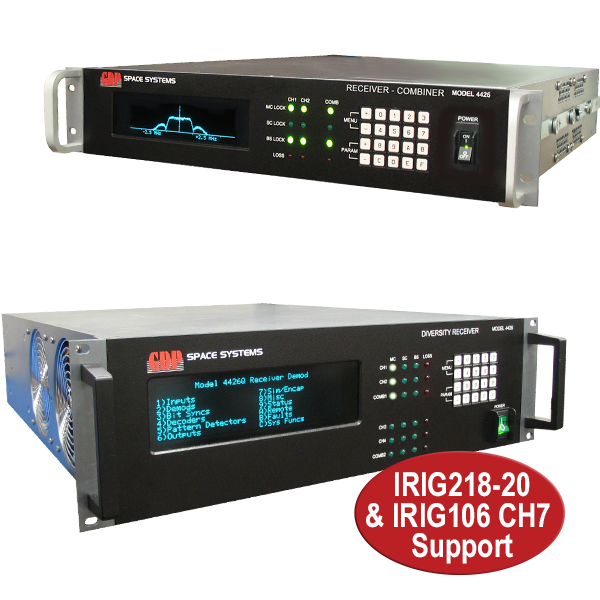
The GDP Model 4426 is a 3rd Generation Digital RF Receiver available in single, dual, or quad channel configurations, designed for telemetry signal reception and processing in a 2U rack-mounted chassis.
Typed specifications85 values
Discloses 3 of 13 fields engineers filter by in this category (category median 2).
- Frequency bands
- UHF CIF (P)-Band · datasheet p.1 UHF optional P (UHF) Band | S RX | C RX (optional) | L Upper L and Lower L Band +5
- Frequency range
- 4 400–5 250 MHz C-Band (optional) · datasheet p.1 4 400–5 250 MHz C-Band, optional | 100–1 150 MHz CIF (P) -Band (optional) | 100–1 100 MHz CIF (P)-Band (optional) | 100–1 150 MHz CIF (P)-Band, optional +3
- Envelope (L×W×H)
- 2U Rack-Mountable Chassis datasheet p.1 1U* Optional
- Data rate
- 20 000 kbps BPSK (Optional) · datasheet p.1 20 000 kbps PCM/FM (Optional) | 20 000 kbps PCM/FM & BPSK (Optional) | 40 000 kbps QPSK (Optional) | 40 000 kbps QPSK/SOQPSK (Optional) +12
- Modulation
- BPSK/QPSK/OQPSK datasheet p.1 CPM (ARTM Tier 2) Optional | PCM/FM (ARTM Tier 0) Std | BPSK | UQPSK* Optional +15
- Data interface
- Ethernet datasheet p.1 Ethernet Control Interface | Ethernet Data Output | other TTL | RS-422 TTL, RS422 (Standard) data output +2
- Operating temperature
- 10–40 °C datasheet p.2 10–40 °C Operational
- Function
- receiver datasheet p.1
- Link use
- ground terminal telemetry receiver, 2U rack-mountable chassis · datasheet p.1
- Link protocol
- AX.25 datasheet p.2 CCSDS optional (Support for Space Applications) | HDLC optional Ethernet data output HDLC/AX.25 | CCSDS | AX.25 optional Ethernet data output HDLC/AX.25 +2
- RF connector
- other IF Inputs & Outputs · datasheet p.1
- Noise figure
- 4 dB max · < 4 dB typ · datasheet p.2
- Survival temperature
- -40–70 °C datasheet p.2 -40–70 °C Storage
- Duplex
- simplex receiver · datasheet p.1
- Channel coding (FEC)
- Reed-Solomon optional, CCSDS · datasheet p.1 LDPC optional, IRIG/CCSDS | convolutional (Viterbi) optional, R=1/2 ... 7/8
- Channel bandwidth
- 255 kHz IF Acquisition / Tracking Range · datasheet p.2
- Board format
- custom 2U Rack-Mountable Chassis · datasheet p.1
Each value is typed with its unit and measurement condition and cites the datasheet page it was taken from. Nothing is guessed: a field that is absent here has not been published by the manufacturer. machine-extracted ✓ checked by NewSpace Market ✓ manufacturer confirmed by the manufacturer.
As published by the supplier8 lines, in the manufacturer's own wording
- RF frequency
- S Band 2185-2485 MHz, Upper L Band 1700-1850 MHz, Lower L Band 1427-1545 MHz
- Data rate
- 50 bps to 10 Mbps (bit sync); up to 20 Mbps optional
- Modulation
- BPSK, QPSK, OQPSK, PCM/FM, SOQPSK-TG, Multi-H CPM, GMSK
- Fec
- LDPC, Viterbi, Reed Solomon
- Noise figure
- < 10 dB
- Dynamic range
- > 80 dB
- Output
- TTL, RS-422; optional IRIG-106 Ch-10 Ethernet
- Form factor
- 2U or 3U rack-mount
About
The 3rd Generation GDP Model 4426 Digital RF Receiver is a state-of-the-art solution for a wide variety of communications link scenarios, available in single, dual, or quad channel configurations within a 2U rack-mounted chassis. Each channel operates independently and integrates an RF Signal Processor, Demodulators, and optional Bit Synchronizers and Frame Synchronizers. An Ultratech Diversity Combiner (Pre-D and Post-D) can be optionally included with dual or quad channel configurations. The receiver features an exceptionally wide dynamic range and supports IRIG 218-20 and IRIG 106 Chapter 7. It incorporates Adaptive Equalization (AEQ) to mitigate multipath distortion and fading effects on telemetry signals, ensuring higher fidelity output. The Model 4426 also supports Low Density Parity Check (LDPC) codes on the downlink and offers a Serial-to-Ethernet function to directly ingest CH7 over the RF link and output transported Ethernet. The unit processes three primary RF Bands: S Band (2185 MHz to 2485 MHz), Upper L Band (1700 MHz to 1850 MHz), and Lower L Band (1427 MHz to 1545 MHz), with additional RF bands like P Band (100 MHz to 1100 MHz) and C-Band available, as well as multi-band options. Demodulation and baseband bit synchronization are entirely performed in the digital domain. Signal acquisition involves scanning the IF within a programmed acquisition band centered on the selected Carrier frequency, and waveforms are also scanned for acquisition at subcarrier frequencies. Once acquired, synchronized signal tracking continuously validates the lock state. Optional FEC decoders are available, and two fully programmable frame synchronizers (pattern detection) are provided with the bit synchronizer option. With the Bit Synchronizer option, data is output via TTL and RS-422. An optional Ethernet output interface allows for the transport of frame synchronized byte-aligned data, with UDP/IP transport for raw data and IRIG-106 Chapter 10 compatible output also available. An encapsulated data and data-quality output can be included to support GDP Best Source Selector products. A new feature includes a 70MHz Test Modulator Output function.
Documentation
- GDP-Model-4426-Digital-Multi-Band-RF-Receiver-Datasheet-02_RevA-04222024.pdf PDF source: gdpspace.com ↗
Need the full ICD, test reports or a specific revision? Ask the supplier directly.