Model RDM207 Digital RF Receiver
 GDP Space Systems
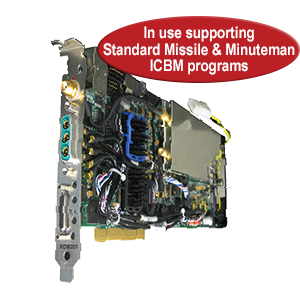
The RDM207 is a single-channel digital RF/IF receiver on a PCI card, offering advanced signal processing, demodulation, and synchronization for various communication link scenarios, including aircraft flight-testing and IRIG106 Chapter 7 data streams.
Typed specifications68 values
Discloses 3 of 13 fields engineers filter by in this category (category median 2).
- Frequency bands
- S datasheet p.1 C optional | other P-Band 100 MHz to 1100 MHz, optional | L Upper L and Lower L Band
- Frequency range
- 1 427–1 545 MHz Lower L Band · datasheet p.2 4 400–5 250 MHz optional (page 2; page 1 lists 4400 MHz to 5500 MHz) | 2 185–2 485 MHz RF Frequency | 100–1 100 MHz RF Frequency (* optional) | 2 185–2 485 MHz S Band +4
- Envelope (L×W×H)
- PCI Single Slot Form Factor · datasheet p.2
- Data rate
- 20 000 kbps Bit Synchronizer PCM/FM & BPSK (* optional) · datasheet p.2 40 000 kbps Bit Synchronizer QPSK/SOQPSK (* optional) | 20 000 kbps PCM/FM Demodulator Data Rate (* optional) | 0.05 kbps min · PCM/FM & BPSK | 20 000 kbps max · PCM/FM & BPSK, optional extended +6
- Modulation
- BPSK PSK Demodulators · datasheet p.2 QPSK PSK Demodulators | OQPSK PSK Demodulators | UQPSK * PSK Demodulators | AQPSK * PSK Demodulators +10
- Data interface
- Ethernet Control Interface (* optional) · datasheet p.2 TTL Data Output | Ethernet Data Output (IRIG 218, IRIG-106 Ch-10*, HDLC/AX.25*) | other PCI Bus (Control Interface) | other PCI Bus (Standard) +3
- Operating temperature
- 10–40 °C Operational · datasheet p.2
- Function
- receiver datasheet p.1
- Link use
- ground terminal telemetry receiver, PCI card · datasheet p.1
- Link protocol
- AX.25 datasheet p.1 other ARTM Tier 0 | other ARTM Tier 1 | other ARTM Tier 2 | proprietary IRIG-106 Chapter 10 compatible output +2
- Noise figure
- 10 dB max · datasheet p.2
- Survival temperature
- -40–85 °C Storage · datasheet p.2
- Duplex
- simplex receiver · datasheet p.1
- Channel coding (FEC)
- Reed-Solomon optional · datasheet p.1 convolutional (Viterbi) Rate 1/2, 1/3*, 3/4*, 7/8* | LDPC optional | Reed-Solomon | LDPC
- Channel bandwidth
- 4 kHz Selectable IF Bandwidths · datasheet p.1
- Board format
- custom PCI Single Slot card · datasheet p.2
Each value is typed with its unit and measurement condition and cites the datasheet page it was taken from. Nothing is guessed: a field that is absent here has not been published by the manufacturer. machine-extracted ✓ checked by NewSpace Market ✓ manufacturer confirmed by the manufacturer.
As published by the supplier7 lines, in the manufacturer's own wording
- Form factor
- Single-slot PCI card
- RF frequency
- S Band 2185-2485 MHz, Upper L Band 1700-1850 MHz, Lower L Band 1427-1545 MHz
- Data rate
- Up to 40 Mbps
- Modulation
- BPSK, QPSK, OQPSK, UQPSK, AQPSK, GMSK, SOQPSK ARTM Tier 1
- Noise figure
- < 10 dB
- Dynamic range
- > 80 dB
- Output
- TTL, RS-422; optional IRIG-106 Ch-10 Ethernet
About
The Model RDM207 Digital RF Receiver provides unparalleled performance, similar to the Model 4426 range-quality Digital RF Receiver product line. It includes optional RF link and noise mitigation improvements such as Viterbi Decoders/Bit Syncs, Adaptive Equalization (AEQ) to mitigate multipath distortion, and Low Density Parity Check (LDPC) coding to improve link margin while using less bandwidth. The unit operates up to 40 Mbps and is capable of supporting aircraft flight-testing. Recent updates allow for acquiring and processing IRIG106 Chapter 7 data streams, outputting the resulting data packets to Ethernet for downstream processing. The RDM207 (PCI) Single Channel Digital RF/IF Receiver is an integrated solution consisting of an RF Signal Processor, 2 Demodulators, 2 Bit Synchronizers, and 2 Frame Synchronizers (Pattern Detectors) contained on a single slot PCI card. This state-of-the-art module offers a compact, cost-competitive, and flexible solution for a wide variety of communications link scenarios. It processes 3 RF Bands: S Band (2185 MHz to 2485 MHz), Upper L Band (1700 MHz to 1850 MHz), and Lower L Band (1427 MHz to 1545 MHz). Additional RF bands are available, including IF (1KHz to 180MHz), P-Band (100 MHz to 1100 MHz), and C-Band, with multi-band options also offered. The demodulation and baseband bit synchronization processes are entirely performed in the digital domain. Signal acquisition is achieved by scanning the IF within a programmed acquisition band centered about the selected Carrier frequency, with PM/PSK waveforms additionally scanned for acquisition at subcarrier frequencies. Once acquired, synchronized signal tracking ensures continuous validation of the lock state. A variety of optional FEC decoders are available, and two fully programmable frame synchronizers (pattern detection) are provided with the bit synchronizer option. Bit Synchronizer data is output via TTL and RS-422 outputs. The unit supports an optional Ethernet output interface for transporting frame-synchronized, byte-aligned data, with UDP/IP transport provided for raw data. IRIG-106 Chapter 10 compatible output is also available, and an encapsulated data and data-quality output may be included to support GDP and RCC Best Source Selector products.
Documentation
Need the full ICD, test reports or a specific revision? Ask the supplier directly.