ISIS Modular Electrical Power Subsystem version 2 (v2)
 ISISPACE Group
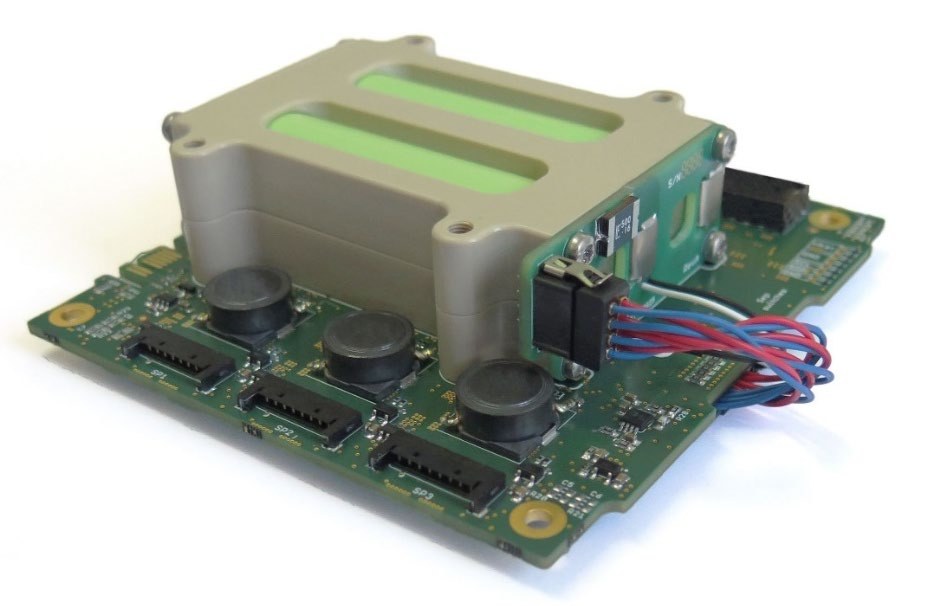
The ISIS Modular Electrical Power Subsystem (IMEPSv2) is a second-generation, flexible EPS designed for larger nano-satellites and microsatellites from 3U upwards, offering improved efficiency and modularity.
Typed specifications97 values
Discloses 11 of 14 fields engineers filter by in this category (category median 7).
- Mass
- 184 g typ. · Type A · datasheet p.9 57.4 g PDU, incl. bottom mount full CSKB | 51.6 g PDU, incl. top mount full CSKB | 252 g Power Battery Pack PBP-4S1P | 48.7 g Power Battery Unit PBU +3
- Envelope (L×W×H)
- 94 x 89 x 21.0 mm3 4 cell BP, Type B and C · datasheet p.9 96 x 92 x 26.5 mm3 IU mainboard + 2 cell BP, Type A | 96 x 92 x 16 mm3 IU mainboard + daughterboard, Type C | 96 x 92 x 11.3 mm3 IU mainboard, Type B | Height 21 mm PBP-4S1P +3
- Outputs (as printed)
- 3.3V, 5V, VBAT datasheet p.2
- Supply voltage
- 4.99 V product page 3.33 V
- Power consumption
- 0.063 W PBU idle consumption (3.9mA @ 16V) · datasheet p.9 0.066 W PCU idle, MCU (3.9 mA @ 16 V) | 0.331 W PCU idle, MPPT circuitry (33.1mA @ 10V, from attached solar p… | 0.066 W PDU idle consumption (4.1mA @ 16V; VD1 at 5V and VD2 at 3.3V,… | 0.093 W Static (Idle) consumption
- Data interface
- I2C datasheet p.2 SPI SPI optional | I2C two independent I2C or UART interfaces | UART two independent I2C or UART interfaces
- Operating temperature
- 10 °C min · With battery, charge (heaters disabled) · datasheet p.7 0 °C min · With battery, charge up to 800 mA | -20 °C min · With battery, discharge | -40 °C min · Without battery | 45 °C max · With battery, charge (heaters disabled) +4
- Unit type
- integrated EPS with battery modular EPS stack: PCU + PBU + PBP battery packs + PDU; confi… · datasheet p.2
- Board format
- CubeSat Kit bus CSKB (top mount / bottom mount full CSKB) · datasheet p.7 PC/104 follows a PC104 form factor
- Bus and outputs type
- hybrid (regulated rails + battery bus) VD0 unregulated (= rail voltage, battery 12.8V-16.0V); VD1/VD… · datasheet p.7
- Unregulated (battery) bus voltage
- 12.8–16 V common power rail / VD0 (battery) · datasheet p.7
- Regulated output voltages
- 5 V VD1 default configuration (user selectable, only below rail v… · datasheet p.7 3.3 V VD2 default configuration 3V3 (user selectable, only below ra… | 12 V max · VD1/VD2 and DaughterBoard VD3-VD6 custom up to 12V
- Switchable outputs
- 4 VD0 (per PDU) · datasheet p.7 4 VD1 (per PDU) | 4 VD2 (per PDU) | 4 VDx, option using DaughterBoard mounted regulator
- Solar array inputs
- 4 MPPT channels per PCU; each additional PCU adds 4x · datasheet p.10
- Solar input voltage window
- 2–13 V PV input min/max voltage (with battery voltage >14V) · datasheet p.10
- Max solar input power
- 39 W max · per channel (5 series, 6 parallel solar cells strings) · datasheet p.10
- Solar array regulation
- MPPT Maximum Power Point Tracking, boost only · datasheet p.10
- Integrated battery energy
- 90 Wh configuration · datasheet p.2 45 Wh per pack (PBP-4S1P); up to three packs per PBU | 135 Wh configuration
- Protections
- Hardware over-current protection datasheet p.2 over-current (LCL) hardware over-current protection, max 3A per channel | watchdog Hardware Supervisor including Watchdog; TT&C Watchdog | over-temperature overcurrent/thermal protection on unit input and each output … | over-voltage overvoltage protection on all domains (TVS diodes) +7
- Connector
- Harness interconnect: multicore wire, Harwin M80 L-Tek datasheet p.7
- Survival temperature
- -20 °C min · Storage condition, up to 1 month · datasheet p.7 -20 °C min · Storage condition, up to 1 year | -20 °C min · Storage condition, up to 3 months | -50 °C min · Storage temperature, Without battery | 50 °C max · Storage condition, up to 1 month +4
- Flight heritage
- Design based on heritage from PEASSS Cubesat (2016) datasheet p.3 Second generation improvements flown on the Hiber 1,2 Cubesats (2018)
- Satellite class
- CubeSat CubeSat missions from 3U upwards · datasheet p.1 nanosat 1-10 kg targeting larger nano- and micro-satellites | microsat 10-100 kg targeting larger nano- and micro-satellites
- Quasi-static load
- 10.8 g design qualification load static, three axes · datasheet p.3
- Max current per output
- 4 A max · max total for VD1, continuous · datasheet p.7 6 A max · max total for VD1, peak | 4 A max · max total for VD2, continuous | 6 A max · max total for VD2, peak | 3 A max · per output channel (limited by OC protection)
- Battery voltage range accepted
- 12.8–16 V battery pack operating voltage (PBP-4S1P); pack min/max 10 mi… · datasheet p.8
- Max battery charge current
- 1.6 A max · battery pack max input current (PBP-4S1P) · datasheet p.9
- MPPT
- yes hardware-based maximum power point tracking · datasheet p.2
- Max solar input current
- 3 A max · per channel · datasheet p.10
- Integrated battery cell configuration
- 4S1P (4 cells in series), Lithium-Ion datasheet p.4
- Battery heater control
- yes battery heating per pack, closed loop controlled · datasheet p.9
- Housekeeping telemetry
- MCU/PCB temperature; voltage, current and power on total unit input, total output for VD0, VD1 regulator, VD2 regulator and each output bus channel; voltage on local board power supply; PBU: per cell voltage, total input/output current, voltage and power, datasheet p.8
- Redundancy
- other tailorable redundancy: multiple PDU's, PCU's, PBU's and PBP's… · datasheet p.2
Each value is typed with its unit and measurement condition and cites the datasheet page it was taken from. Nothing is guessed: a field that is absent here has not been published by the manufacturer. machine-extracted ✓ checked by NewSpace Market ✓ manufacturer confirmed by the manufacturer.
As published by the supplier18 lines, in the manufacturer's own wording
- Manufacturer
- ISISPACE
- Operating temperature
- -40…+85 °C
- Storage temperature
- -50…+65 °C
- Storage lifetime (at relative humidity < 60 %)
- 12 months
- Battery Operational temperature (charge, heaters disabled)
- +10…+45 °C
- Battery Operational temperature (charge up to 800 mA)
- 0…+45 °C
- Battery Operational temperature (discharge)
- -20…+60 °C
- Static (Idle) consumption
- 93 mW
- Maximum input current PDU section
- 4.35 A
- VD0 Number of output channels (Type A and B)
- 1
- VD0 Number of output channels (Type C)
- 1+3
- VD0 Output max. current per channel on PIU
- 3.01 A
- VD0 Output max. current per channel on PIU-DB (Type C)
- 3.3 A
- VD1 Number of output channels
- 4
- VD1 Output voltage unloaded
- 4.99 V
- VD1 Output max. current per channel
- 3.01 A
- VD2 Number of output channels
- 4
- VD2 Output voltage unloaded
- 3.33 V
About
The ISIS Modular Electrical Power Subsystem version 2 (v2) is the second-generation modular EPS designed and manufactured by ISIS. IMEPSv2 is engineered as a flexible Electrical Power Subsystem targeting larger nano-satellites and microsatellites, specifically those from 3U upwards. Utilizing recent high-performance technology, this EPS provides improved efficiency compared to its predecessor while simultaneously minimizing electromagnetic interference (EMI). Its modular architecture allows the EPS to be precisely tailored to the specific needs of the satellite platform without requiring extensive customization. The distributed design philosophy underpinning the IMEPS design offers unprecedented flexibility in terms of output bus count and voltage. This design also enables tailorable redundancy to be applied to selectable parts of the platform, depending on the critical requirements of the mission. Key features include a modular solution with multiple PC104 form factor boards, ideal for 3U platforms and up, and communication over two independent I2C or UART interfaces, with SPI as an optional extra. The system incorporates FRAM-based MCUs for enhanced radiation tolerance, hardware over-current protection, and hardware-based maximum power point tracking. A hardware supervisor, including a watchdog, is also integrated. The solar panel interface utilizes GaN-FETs. Output load channels feature buck-regulated power, hardware-based over-current and reverse-current protection, and over-voltage protection through TVS diodes. They also include turn-on voltage ramp control (soft start) and software-configurable auto-enable and latch-off retry enable timings. Accurate voltage, current, and power sensing are available on each channel, along with rich housekeeping telemetry. The system boasts very low idle consumption when no output channels are enabled. The IMEPS consists of four types of elements: the ISIS Power Conditioning Unit (IPCU) for solar panel input to a common power rail, the ISIS Power Battery Unit (IPBU) for secondary power storage and retrieval control, the ISIS Power Battery Pack (IPBP) which is a battery holder with an integrated fuse, and the ISIS Power Distribution Unit (IPDU) for power regulation to attached subsystem loads. One or more of each of these units can be combined to form the complete platform EPS.
Documentation
Need the full ICD, test reports or a specific revision? Ask the supplier directly.