OPTIMUS Battery
 AAC Clyde Space
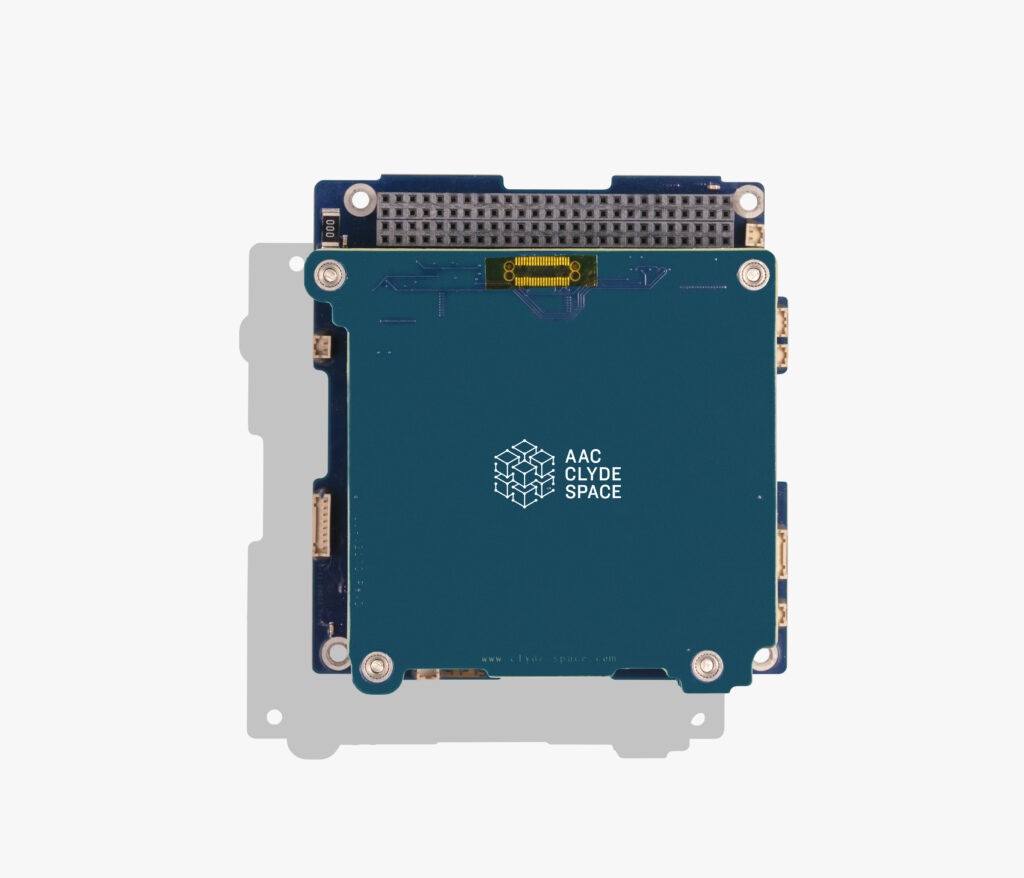
The OPTIMUS Battery is a highly reliable and scalable CubeSat battery range with extensive flight heritage, featuring integrated thermostatically controlled heaters and multiple protection systems.
Typed specifications64 values
Discloses 6 of 12 fields engineers filter by in this category (category median 5).
- Energy
- 30 Wh OPTIMUS-30 · datasheet p.2 40 Wh OPTIMUS-40 | 80 Wh OPTIMUS-80
- Mass
- 268 g OPTIMUS-30, typical · datasheet p.2 335 g OPTIMUS-40, typical | 670 g OPTIMUS-80, typical | 268 g typ. · OPTIMUS-30 | 335 g typ. · OPTIMUS-40 +1
- Cell chemistry
- Lithium Polymer datasheet p.2
- Envelope (L×W×H)
- 95.89 mm x 90.17 mm x 21.55 mm OPTIMUS-30 · datasheet p.2 95.89 x 90.17 x 21.55 mm OPTIMUS-30 (height from top PCB to lowest component) | 95.89 mm x 90.17 mm x 27.35 mm OPTIMUS-40 | 95.89 x 90.17 x 27.35 mm OPTIMUS-40 (height from top PCB to lowest component) | 95.89 mm x 90.17 mm x 56.94 mm OPTIMUS-80 +1
- Supply voltage
- 6.2 V min · Full Discharge Voltage, typical · datasheet p.2 6.2 V min · Discharge Voltage Limit, min | 8.4 V max · Charge Voltage Limit, max | 6.2–8.4 V charge voltage limit 8.4 V max / discharge voltage limit 6.2 … | 8.26 V nom. · EoC voltage (typical) +1
- Power consumption
- 0.1 W Quiescent Power Consumption, <, 30 Wh & 40 Wh · datasheet p.2 0.2 W Quiescent Power Consumption, <, 80 Wh | 0.1 W max · quiescent power consumption, 30 Wh & 40 Wh | 0.2 W max · quiescent power consumption, 80 Wh
- Data interface
- I2C datasheet p.2 I2C serial ports
- Operating temperature
- -10–50 °C datasheet p.2 -10–50 °C operating temperature
- TRL
- 9 product page
- Max continuous discharge current
- 1.95 A nom. · OPTIMUS-30 · datasheet p.2 1.95 A OPTIMUS-30, charge/discharge current | 2.6 A OPTIMUS-40, charge/discharge current | 5.2 A OPTIMUS-80, charge/discharge current | 2.6 A nom. · OPTIMUS-40 +1
- Survival temperature
- -20–60 °C 1 Month · datasheet p.2 -20–20 °C 1 Year | -20–45 °C 3 Months | -10–10 °C Recommended | -20–60 °C storage, 1 month +3
- Flight heritage
- Flown on over 100 missions spanning almost two decades, especially US CubeSat missions; qualified to NASA standards EP-Wi-032; compatible with ISS deployment safety requirements datasheet p.1
- Satellite class
- CubeSat especially US CubeSat missions · datasheet p.1
- Missions flown
- 100 datasheet p.1 100 min · demonstrated on-orbit on over 100 missions
- Max charge current
- 1.95 A nom. · OPTIMUS-30 · datasheet p.2 1.95 A OPTIMUS-30, charge/discharge current | 2.6 A OPTIMUS-40, charge/discharge current | 5.2 A OPTIMUS-80, charge/discharge current | 2.6 A nom. · OPTIMUS-40 +1
- Built-in heater
- yes autonomous integrated heater systems · datasheet p.1
- Board format
- PC/104 Standard CubeSat PC104 · datasheet p.2
- Protections
- over-charge (OV) over-voltage protection · datasheet p.1 other string over-current protection | over-discharge (UV) undervoltage protection | over-discharge (UV) | over-charge (OV) +2
Each value is typed with its unit and measurement condition and cites the datasheet page it was taken from. Nothing is guessed: a field that is absent here has not been published by the manufacturer. machine-extracted ✓ checked by NewSpace Market ✓ manufacturer confirmed by the manufacturer.
As published by the supplier48 lines, in the manufacturer's own wording
- TRL
- 9
- Flown since
- 2014
- Available capacities
- 30, 40 & 80 Whr
- Battery type
- High quality lithium-ion battery
- Qualification
- Qualified to NASA standards EP-Wi-032
- Heaters
- Integrated thermostatically controlled heaters
- Compatibility
- Compatible with International Space Station deployment safety requirements
- Protection
- Under-voltage and over-voltage protection
- Protection (2)
- String over-current protection
- Material
- Lithium Polymer
- Storage temperature recommended
- -10°C to +10°C
- Storage temperature 1 year
- -20°C to +20°C
- Storage temperature 3 months
- -20°C to +45°C
- Storage temperature 1 month
- -20°C to +60°C
- Vacuum
- 10-5 torr
- Operating temperature
- -10°C to +50°C
- Vibration
- To [RD-2]
- Eoc voltage
- 8.26 V (typical)
- Full discharge voltage
- 6.2 V (typical)
- Charge voltage limit
- 8.4 V (max)
- Discharge voltage limit
- 6.2 V (min)
- Charge/discharge current rate
- 1.53 (fraction of capacity) discharge voltage limit: 3 V
- Quiescent power consumption (30 Wh & 40 Wh)
- < 0.1 W
- Quiescent power consumption (80 Wh)
- < 0.2 W
- Interfaces
- Standard CubeSat PC104
- Power buses
- 3V3 and 5 V
- Serial ports
- I2C
- Model
- OPTIMUS-30
- Capacity
- 30 Wh
- Mass (typical)
- 268 g
- Length
- 95.89 mm
- Width
- 90.17 mm
- Height*
- 21.55 mm
- Charge/discharge current
- 1.95 A
- Model (2)
- OPTIMUS-40
- Capacity (2)
- 40 Wh
- Mass (typical) (2)
- 335 g
- Length (2)
- 95.89 mm
- Width (2)
- 90.17 mm
- Height* (2)
- 27.35 mm
- Charge/discharge current (2)
- 2.6 A
- Model (3)
- OPTIMUS-80
- Capacity (3)
- 80 Wh
- Mass (typical) (3)
- 670 g
- Length (3)
- 95.89 mm
- Width (3)
- 90.17 mm
- Height* (3)
- 56.94 mm
- Charge/discharge current (3)
- 5.2 A
About
The AAC Clyde Space OPTIMUS range of CubeSat batteries are among the most flown spacecraft batteries in history, with thousands of units shipped and hundreds on orbit, offering unrivalled on-orbit heritage spanning almost two decades. These batteries are scalable to mission requirements and come with built-in features such as thermostatically controlled heaters and sensors. The design incorporates strings of cells connected in parallel with cell protection electronics, providing robustness, resilience, and inherent redundancy. This parallel string architecture also allows for easy and safe scaling to meet diverse mission requirements. The OPTIMUS batteries are optimized for Low Earth Orbit (LEO) missions with a maximum altitude of 850km and are compatible with a wide variety of launch platforms, including manned missions when integrated into suitable platforms. For manned flight platforms, additional qualification and acceptance testing can be performed to meet necessary safety conditions. All battery systems include autonomous integrated heater systems to enhance operation at low temperatures and multiple protection systems at cell, battery, and system levels to automatically respond to external fault conditions, safeguarding the battery and wider system from irrecoverable damage. The OPTIMUS Battery range is compatible with International Space Station deployment safety requirements. AAC Clyde Space ensures consistent quality by purchasing battery cells in large batches and subjecting them to extensive LOT acceptance testing, including qualification to NASA ISS requirements for a significant portion of cells. The highly scalable OPTIMUS battery range is available in 30Wh, 40Wh, and 80Wh capacities, with larger capacities available upon request. Inbuilt protections include under-voltage protection, over-voltage protection, and string over-current protection, based on over a decade of design heritage. The batteries are designed for integration with spacecraft that have an EPS compatible with lithium-ion polymer technology and can be easily combined with the STARBUCK EPS range. They have demonstrated excellent performance on orbit on over 100 missions over the last 10 or more years.
Documentation
Need the full ICD, test reports or a specific revision? Ask the supplier directly.