ASTRIX 1090 Inertial Measurement / Accelerometer Unit
 Airbus Defence and Space
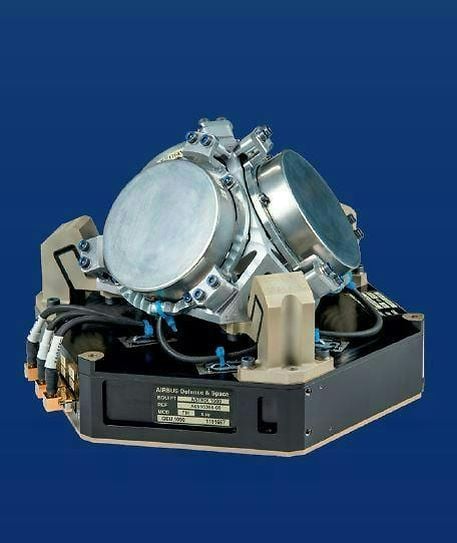
Three-axis fibre-optic inertial unit from the ASTRIX 1000 series offering low angular random walk and optional accelerometer channels for navigation.
Typed specifications64 values
Discloses 9 of 11 fields engineers filter by in this category (category median 3).
- Gyro range
- 20 °/s +/- full performance measurement range · datasheet p.2 140 °/s +/- measurement range | 20 °/s Full performance measurement range | 140 °/s Measurement range
- Mass
- 4 500 g nom. · datasheet p.2 4 500 g
- Bias instability
- 0.09 °/h Repeatability after launch environment · datasheet p.2 0.3 °/h Stability end-of life (all effects included) | 0.01 °/h Stability over 1 hour | 0.3 °/h Thermal sensitivity (over 15°C) | 0.3 °/h max · stability end-of-life (all effects included) +2
- Envelope (L×W×H)
- ø 263 x h 192mm footprint datasheet p.2
- Angle random walk
- 0.005 °/√h datasheet p.2 0.005 °/√h max
- Supply voltage
- 22–50 V power bus · datasheet p.2
- Power consumption
- 13.5 W nom. · datasheet p.2 13.5 W
- Data interface
- MIL-STD-1553 datasheet p.2 MIL-STD-1553 1553B | RS-422 stimulation for AOCS test | MIL-STD-1553 support | MIL-STD-1553 Synchro hardware +5
- Operating temperature
- -25–60 °C operating · datasheet p.2
- Radiation tolerance (TID)
- 100 krad datasheet p.2 100 krad total dose, SEP tolerant, latch-up immune
- Design lifetime
- 15 years datasheet p.2 15 years max · up to 15 years, no wear-out
- Unit type
- IMU (gyros + accelerometers) three-axis inertial measurement unit, optional accelerometers · datasheet p.1
- Gyro technology
- FOG datasheet p.2
- Axes
- 3 3-axis inertial detection · datasheet p.2
- Random vibration
- 20 g RMS random · datasheet p.2
- Flight heritage
- 3+ million flight hours product page
- Satellite class
- GEO datasheet p.2
- Missions flown
- 3 000 000 datasheet p.2
- Quasi-static load
- 25 g datasheet p.2
- Shock qualification
- 2 000 g over 1000 Hz to 10 kHz · datasheet p.2
- Accelerometers included
- yes option for a full IMU with implementation of 3 accelerometers… · datasheet p.2
- Bias repeatability
- 0.09 °/h max · repeatability after launch environment · datasheet p.2
- Scale factor error
- 50 ppm accelerometer linearity - asymmetry 3 sigma (50 or 300 ppm) · datasheet p.2 200 ppm max · accelerometer repeatability after launch environment 3 sigma | 1 000 ppm max · accelerometer stability end-of-life 3 sigma | 200 ppm max · accelerometer thermal sensitivity (over 15 °C) 3 sigma | 500 ppm max · gyro linearity - asymmetry 3 sigma +4
- Start-up time
- 3 s start-up time · datasheet p.2 3 s max · turn-on
- Accelerometer range
- 0.1 g +/- full performance measurement range (0.1 g option) · datasheet p.2 1.1 g +/- full performance measurement range (1.1 g option) | 20 g measurement range (+20 g option)
- Accelerometer bias instability
- 3 µg accelerometer bias stability over 1 hour (3 or 20 µg) · datasheet p.2 200 µg accelerometer thermal sensitivity (over 15 °C), typ. 35 µg | 500 µg max · accelerometer stability end-of-life | 20 µg accelerometer bias stability over 1 hour (3 or 20 µg)
- Velocity random walk
- 5 m/s/√h Velocity Random Noise 1 sigma, printed as "5 10-6 g/sqrtHz" · datasheet p.2
Each value is typed with its unit and measurement condition and cites the datasheet page it was taken from. Nothing is guessed: a field that is absent here has not been published by the manufacturer. machine-extracted ✓ checked by NewSpace Market ✓ manufacturer confirmed by the manufacturer.
As published by the supplier22 lines, in the manufacturer's own wording
- Angular random walk
- <0.005°/√h
- Bias stability
- <0.01°/h
- Configuration
- Optional accelerometer channels for full inertial navigation
- Flight heritage
- 3+ million flight hours
- Mass
- 4.5 kg
- Dimensions
- ø 263 x h 192 mm
- Power
- 13.5 W
- Operating temperature
- -25…+60 °C
- Supply voltage
- 22-50 V
- Lifetime
- 15 years
- Interface
- 1553, RS422
- Start-up time
- 3 s
- Linear motion measurement range
- ± 0.1 g or ±1.1 g
- Linear motion measurement range (2)
- 1.1 g or +20 g
- Accelerometer scale factor angular resolution
- 5 µm/s / LSB
- Accelerometer scale factor linearity - asymmetry 3 σ
- 50 or 300 ppm
- Accelerometer scale factor thermal sensitivity (over 15°C) 3
- < 200 ppm
- Accelerometer bias stability over 1 hour
- 3 or 20 µg
- Accelerometer bias thermal sensitivity (over 15°C)
- 200 µg
- Accelerometer bias repeatability after launch environment
- 150 µg
- Velocity Random Noise 1σ
- 5 10-6 g/√Hz
- Quantification Noise (at 100 Hz) 1 σ
- < 500 µg
About
The ASTRIX 1090 is a member of Airbus’ ASTRIX 1000 series of three-axis inertial detection systems, combining fibre-optic gyroscope sensing with an angular random walk below 0.005°/√h and bias stability below 0.01°/h. The unit can be configured with accelerometer channels to provide full inertial navigation capability, making it suitable for deep-space and high-precision AOCS applications.
ASTRIX 1090 shares the same rugged, HiRel-parts design philosophy as the rest of the ASTRIX family and has accumulated more than three million flight hours across multiple missions, giving programme teams a low-risk path to precision inertial sensing.
Documentation
Need the full ICD, test reports or a specific revision? Ask the supplier directly.