AOCS & GNC Sensors
 Airbus Defence and Space
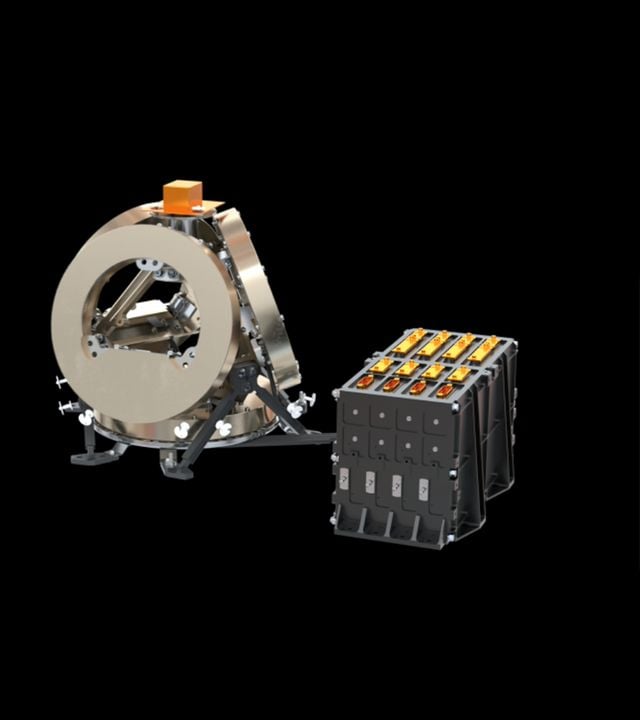
Airbus offers a comprehensive range of avionics sensors for precise attitude control and navigation in space, including Astrix fibre-optic gyroscopes, Jena-Optronik star sensors, and BASS Bi-Axis Sun Sensors.
Typed specifications35 values
Discloses 8 of 11 fields engineers filter by in this category (category median 3).
- Gyro range
- 60 °/s min · full performance, qualified · datasheet p.2 60 °/s min · measurement range (full performance), qualified
- Mass
- 1 400 g datasheet p.2
- Bias instability
- 0.02 °/h max · bias stability over 1 h (steady temperature) · datasheet p.2 0.2 °/h bias stability end of life (all effects included) | 0.2 °/h end of life, all effects included | 0.02 °/h max · steady temperature, over 1 h
- Envelope (L×W×H)
- 100 x 100 x 100 mm datasheet p.2
- Angle random walk
- 0.003 °/√h high performance design · datasheet p.2 0.005 °/√h max · standard performance design
- Supply voltage
- 20 V min · datasheet p.2 52 V max | 20–52 V power bus
- Power consumption
- 7 W datasheet p.2
- Data interface
- RS-422 datasheet p.2 RS-422 2x RS422 / RS485 full duplex | RS-485 | RS-485 2x RS422 / RS485 full duplex
- Operating temperature
- -20 °C min · datasheet p.2 65 °C max | -20–65 °C operating
- Radiation tolerance (TID)
- 25 krad min · at component level · datasheet p.2
- Design lifetime
- 15 years max · datasheet p.2 15 years max · up to 15 years
- Unit type
- gyroscope (rate sensor) 3-axis Fiber-Optic Gyroscope · datasheet p.1
- Gyro technology
- FOG datasheet p.1
- Axes
- 3 3-axis · datasheet p.1
- Random vibration
- 20 g RMS random · datasheet p.2
- Satellite class
- GEO compatible with geostationary orbits including electrical orb… · datasheet p.1
- Missions flown
- 40 datasheet p.2
- Quasi-static load
- 25 g datasheet p.2
- Shock qualification
- 2 000 g from 1 000 Hz to 10 kHz · datasheet p.2
- Scale factor error
- 200 ppm max · scale factor linearity @ 3 sigma · datasheet p.2 200 ppm max · scale factor stability after launch @ 3 sigma (all effects in…
- Start-up time
- 1 s max · start-up and access to relevant data · datasheet p.2
Each value is typed with its unit and measurement condition and cites the datasheet page it was taken from. Nothing is guessed: a field that is absent here has not been published by the manufacturer. machine-extracted ✓ checked by NewSpace Market ✓ manufacturer confirmed by the manufacturer.
As published by the supplier22 lines, in the manufacturer's own wording
- Astrix 200 bias stability
- <0.0005°/h
- Astrix 120 bias stability
- <0.01°/h, startup <3s
- Interfaces
- 1553B, RS422
- Mission life
- 15+ years continuous operation
- Bias stability over 1 h (steady temperature)
- < 0.02°/h
- Bias stability end of life (all effects included)
- 0.2°/h
- Scale factor stability after launch @ 3σ (all effects includ
- < 200 ppm
- Scale factor linearity @ 3σ
- < 200 ppm
- Measurement range (full performance)
- > 60°/s qualified
- ARW standard performance design
- < 0.005°/√h
- ARW high performance design
- 0,0025 °/ √h
- Operating temperature
- -20°C to 65°C
- Vibration
- 25 g sine and 20 g rms random
- Shock
- 2000 g from 1000 Hz to 10 kHz
- Radiation
- > 25 krad at component level
- Lifetime
- up to 15 years
- Mass
- 1.4 kg
- Dimensions
- 100 x 100 x 100 mm
- Supply voltage
- 20 V – 52 V
- Start-up and access to relevant data
- <1 s
- Interface
- 2x RS422 / RS485 full duplex
- Power
- 7 W
About
Airbus provides a diverse portfolio of avionics sensors engineered for precision, reliability, and high performance across various space missions. The Astrix series features advanced fibre-optic gyroscopes, known for their exceptional inertial measurement accuracy and remarkable bias stability, as low as 0.0005°/h. These gyroscopes are designed for extended mission lifetimes, exceeding 15 years. Complementing these are Jena-Optronik’s star sensors, which deliver precise attitude control capabilities for a wide array of applications, ranging from Earth observation to deep space exploration. These star sensors are built to ensure robust performance even under harsh environmental conditions encountered in space. Additionally, the BASS Bi-Axis Sun Sensors offer reliable sun detection with a broad ±90° field of view. These sun sensors are characterized by their low mass and high thermal resistance, making them particularly well-suited for missions in Low Earth Orbit (LEO), Geostationary Earth Orbit (GEO), and interplanetary trajectories.
Documentation
- Datasheet_SpE_Astrix_NS_2023.pdf PDF source: airbus.web.factory.eu.airbus.com ↗
- Datasheet_SpE_ASTRIX200_2022.pdf PDF source: airbus.web.factory.eu.airbus.com ↗
- Datasheet_SpE_ASTRIX120_2022.pdf PDF source: airbus.web.factory.eu.airbus.com ↗
- Datasheet_SpE_ASTRIX1090_2022.pdf PDF source: airbus.web.factory.eu.airbus.com ↗
- Datasheet_SpE_BASS_2022.pdf PDF source: airbus.web.factory.eu.airbus.com ↗
Need the full ICD, test reports or a specific revision? Ask the supplier directly.