High Performance Radiator technology (HiPeR) Flexlinks
 Airbus Defence and Space
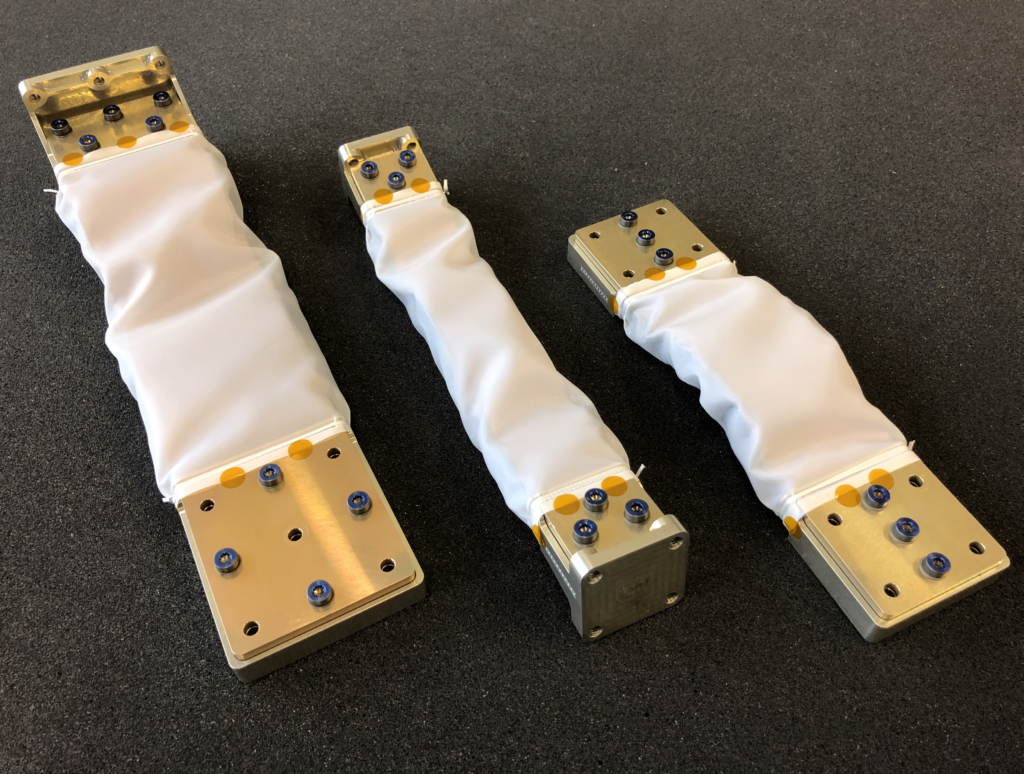
HiPeR Flexlinks are highly flexible thermal straps developed by Airbus for spacecraft thermal control, offering superior conductance-to-mass ratio compared to traditional solutions.
Typed specifications83 values
Discloses 2 of 7 fields engineers filter by in this category (category median 1).
- Thermal conductance
- 1.2 W/K min · PAR-PAR, 100 mm · datasheet p.2 1.1 W/K min · PAR-PAR, 120 mm | 1 W/K min · PAR-PAR, 140 mm | 0.9 W/K min · PAR-PAR, 160 mm | 1.5 W/K min · PAR-PAR, 60 mm +69
- Mass
- 120 g 120 gr for typical 1 W/K thermal straps · datasheet p.2 120 g for typical 1 W/K thermal straps
- TRL
- 9 product page
- Product type
- thermal strap datasheet p.1
- Material
- thin sheets of Pyrolytic Graphite (PG) sandwiched between metal plates, wrapped in a mesh sleeve datasheet p.1
- Length
- 60 mm min · PG stack standard options 60/80/100/120/140/160 mm · datasheet p.2 160 mm max · PG stack standard options 60/80/100/120/140/160 mm
- Flight heritage
- Flight proven datasheet p.1
- Mounting
- bolt or screw pattern standard M4 connections · datasheet p.2
Each value is typed with its unit and measurement condition and cites the datasheet page it was taken from. Nothing is guessed: a field that is absent here has not been published by the manufacturer. machine-extracted ✓ checked by NewSpace Market ✓ manufacturer confirmed by the manufacturer.
As published by the supplier21 lines, in the manufacturer's own wording
- Conductance-to-mass ratio
- three to five times higher than traditional solutions (W/K per kg)
- Lead time
- about 4 months (average)
- TRL
- 9
- Flight heritage
- on-board missions in Telecom, Science, Earth Observation and megaconstellations
- Conductivity
- up to 3.6 W/K
- Stiffness
- <1.5 N/mm
- Length of Pyrolytic Graphite (PG) stack
- 60 / 80 / 100 / 120 / 140 / 160 mm
- Interface Width (PAR-01)
- 35 mm
- Interface Length (PAR-01)
- 30 mm
- Interface Width (PAR-02)
- 30 mm
- Interface Length (PAR-02)
- 40 mm
- Interface Width (PAR-03)
- 40 mm
- Interface Length (PAR-03)
- 40 mm
- Interface Width (PAR-04)
- 45 mm
- Interface Length (PAR-04)
- 45 mm
- Interface Width (PAR-05)
- 30 mm
- Interface Length (PAR-05)
- 50 mm
- Interface Width (PAR-06)
- 50 mm
- Interface Length (PAR-06)
- 40 mm
- Interface Width (PAR-07)
- 50 mm
- Interface Length (PAR-07)
- 50 mm
About
Airbus’s High Performance Radiator technology (HiPeR) addresses the challenges of thermal control in space. The HiPeR Flexlinks are thermal straps designed to conduct heat on-board spacecraft with unprecedented capability. They are extremely flexible and boast a conductance-to-mass ratio (W/K per kg) that is three to five times higher than traditional thermal control solutions. These straps provide a versatile solution for various thermal control requirements while maintaining mechanical decoupling. They are available as catalogue items with an average lead time of approximately 4 months and are offered to any commercial customer worldwide. The HiPeR Flexlinks have achieved TRL9 and are currently deployed on missions across various sectors, including Telecommunications, Science, Earth Observation, and megaconstellations.
Documentation
Need the full ICD, test reports or a specific revision? Ask the supplier directly.