BR-MOD (Series)
 AVCOM of Virginia
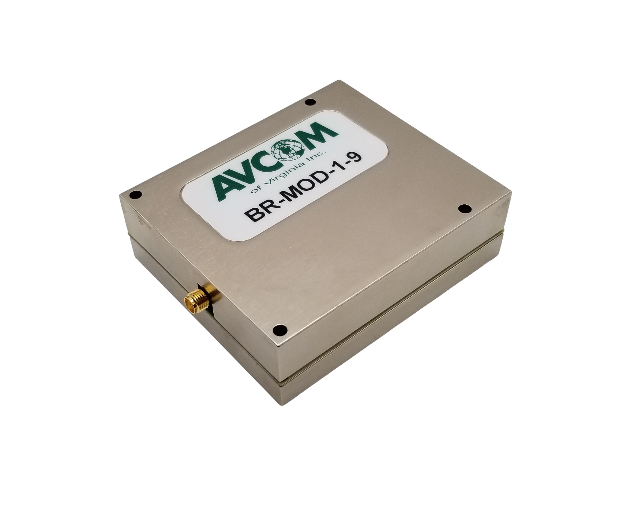
The BR-MOD (Series) is a satellite beacon receiver designed for embedded applications, capable of tracking CW, BPSK, and DVB-like carrier signals, and also functions as a full-function spectrum analyzer.
Typed specifications43 values
Discloses 6 of 13 fields engineers filter by in this category (category median 3).
- Mass
- 200 g datasheet p.4 201.28 g
- Frequency range
- 900–2 200 MHz model 2290 (Default) · datasheet p.2 400–3 000 MHz model 3040 | 70–6 000 MHz model 6070
- Envelope (L×W×H)
- 3 in. x 3.5 in. x 1.062 in. datasheet p.4
- RX sensitivity
- -100 dBm -40 REF LVL · datasheet p.2 -100 dBm RF sensitivity (-40 REF LVL)
- Modulation
- Wideband carrier signals (DVB-like) (No Demod) CEPT (CARRIER EDGE POWER TRACKING) · datasheet p.3 CW, or BPSK signals (No Demod) PEAK FOLLOWING | other tracking receiver: CW or BPSK carrier, no demodulation | other tracking receiver: wideband DVB-like carrier, no demodulation
- Supply voltage
- 25 V product page 8–33 V
- Power consumption
- 3 W max · datasheet p.4
- Data interface
- Ethernet datasheet p.4 Ethernet 10/100 | RS-422 RS422 or RS232 selectable | RS-422 | RS-232 RS422 or RS232 selectable +2
- Operating temperature
- -40 °C product page -40–70 °C
- Function
- receiver satellite beacon receiver · datasheet p.1
- Link use
- ground terminal beacon tracking, On-The-Move and fixed-site · datasheet p.1
- Link protocol
- other DVB-like carriers · datasheet p.1
- RF connector
- SMA input connectors, 1 or 2 inputs · datasheet p.2
- Connector
- SMA datasheet p.2 4-pin Molex | 9-pin Molex | 9-pin Molex | 3-pin Molex
- Survival temperature
- -40 °C product page -40–85 °C Storage
- Duplex
- simplex receiver · datasheet p.1
- Channel bandwidth
- 1 kHz datasheet p.2 3 kHz | 10 kHz | 30 kHz | 100 kHz +2
Each value is typed with its unit and measurement condition and cites the datasheet page it was taken from. Nothing is guessed: a field that is absent here has not been published by the manufacturer. machine-extracted ✓ checked by NewSpace Market ✓ manufacturer confirmed by the manufacturer.
As published by the supplier60 lines, in the manufacturer's own wording
- Input connectors
- SMA
- Nominal input impedance
- 50 Ω (SMA)
- Max DC input voltage
- 25 V
- Input frequency range: model 2290 (Default)
- MIN (MHz) 900, MAX (MHz) 2200
- Input frequency range: model 3040
- MIN (MHz) 400, MAX (MHz) 3000
- Input frequency range: model 6070
- MIN (MHz) 70, MAX (MHz) 6000
- Max span width
- 1300 MHz
- Min tuning step size
- 1 kHz
- Resolution bandwidth
- 1 kHz, 3 kHz, 10 kHz, 30 kHz, 100 kHz, 300 kHz, 1 MHz
- Reference levels
- -40 dBm, -30 dBm, -20 dBm, -10 dBm
- Maximum input power level
- -10 dBm
- RF sensitivity (-40 REF LVL)
- -100 dBm
- Spur free dynamic range (3kHz RBW)
- 60 dB
- Noise floor (-40 REF LVL, 3kHz RBW)
- -100 dBm, -134 dB/Hz
- Noise floor (-10 REF LVL, 3kHz RBW)
- -70 dBm, -104 dB/Hz
- Isolation between inputs
- >40 dB typical
- Amplitude accuracy
- +/- 1 dB typical
- Frequency accuracy
- +/- 1 kHz typical
- Phase noise (2 ghz): offset frequency 10 khz
- -100 dBc/Hz
- Phase noise (2 ghz): offset frequency 100 khz
- -100 dBc/Hz
- Phase noise (2 ghz): offset frequency 1 mhz
- -109 dBc/Hz
- Tracking algorithm
- PEAK FOLLOWING, CEPT (CARRIER EDGE POWER TRACKING)
- Beacon/carrier type
- CW, or BPSK signals (No Demod); Wideband carrier signals (DVB-like) (No Demod)
- Detection bandwidth
- 10 to 750 kHz; N/A
- Tracking bandwidth
- 10 to 150 kHz; N/A
- Cept bandwidth
- N/A; 1 MHz to 30 MHz
- Update rate / track rate
- 10 Hz, 25 Hz, or 100 Hz; 10 Hz, or 25 Hz
- Acquisition/tracking level
- Minimum C/N0: 39 dB-Hz; Minimum C/N0: 54 dB-Hz
- Detected level filtering
- Low-Pass Filter: 0.25 Hz, 0.5 Hz, 1 Hz, 2 Hz, or 3 Hz
- Acquisition time
- <1 second typical
- Adjustable delay before lock
- 0 to 5000 milliseconds
- Beacon receiver operation notes
- Only one beacon receiver operation may run at a time. The operation must be stopped before modifying settings.
- Special feature
- Spectrum Analyzer features are available when Beacon Receiver is not running
- Ethernet
- 10/100, Magnetics on-board, DHCP or Static, 4-pin Molex
- Serial
- RS422 or RS232 (Selectable via external select pin) 115200 8n1, 9-pin Molex
- USB
- 115200 8n1, 3-pin Molex
- Beacon receiver outputs
- Analog and Digital outputs, 6-pin Molex
- M & c: evo gui (ETHERNET)
- Yes
- M & c: posix-c api sbs2api (ETHERNET)
- Yes
- M & c: web-gui (ETHERNET)
- Yes
- M & c: posix-c api sbs2api (SERIAL)
- Yes
- M & c: text-based api (SERIAL)
- Yes
- M & c: evo gui (USB)
- Yes
- M & c: posix-c api sbs2api (USB)
- Yes
- M & c: text-based api (USB)
- Yes
- Connector
- 6-pin Molex
- Analog signal strength indicator output
- 0 to 10 VDC, 10 mA
- Analog slope
- 0.1 to 3.0 V/dB
- Analog slope polarity
- Positive or Negative
- Analog output filtering
- Low-Pass, 0.5 Hz, fixed.
- Digital lock indicator output
- 0 – 3.3 VDC
- Digital lock indicator output polarity
- Adjustable (H=LOCK or L=LOCK)
- Power connector
- 2-pin Molex
- Power supply
- 8 – 33 VDC, < 3 W with reverse polarity, surge, and spike protection
- Dimensions
- 3 in. x 3.5 in. x 1.062 in.
- Mass
- 7.1 oz; 200 g
- Operating temperature
- -40°C to 70°C
- Storage temperature
- -40°C to 85°C
- Humidity
- 0 to 95%, non-condensing
- Max operating altitude
- 40,000 ft; 12,000 m
About
The BR-MOD-1-9-B is a satellite beacon receiver built on a new platform to address modern system challenges. This robust product offers reliable operation in embedded applications, capable of quickly acquiring and tracking CW satellite beacon carriers in both On-the-Move and fixed-site scenarios. It can lock onto and track BPSK-type carrier signals and uniquely tracks DVB-like carriers using Avcom’s exclusive Carrier-Edge-Power-Tracking (CEPT) function. The receiver provides a 0 to 10 VDC voltage output proportional to the input signal. A distinctive feature is its ability to function as a full-function spectrum analyzer when the beacon receiver is not in use, eliminating the need for a separate monitoring device. Connectivity options include Ethernet, USB, or serial, supporting communication via WEB-GUI, POSIX-C API, text-based API, and Avcom’s EVO GUI, making it suitable for integration with complex M&C systems or simple microprocessor-based systems. It features an extended temperature range, low SWaP (Size, Weight, and Power), multiple inputs, and L-Band and extended frequency band options.
Documentation
Need the full ICD, test reports or a specific revision? Ask the supplier directly.