Teledyne e2v Space Imaging Detectors — CCDs and HgCdTe Infrared Sensors for Astronomy
 Teledyne e2v
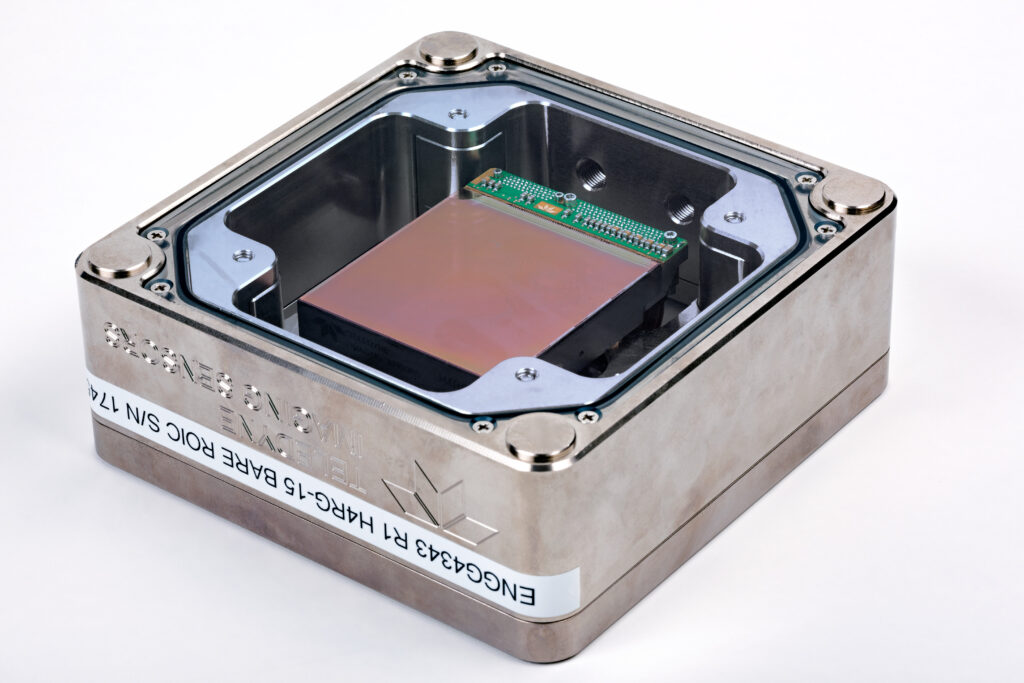
Teledyne Technologies is a US industrial conglomerate whose Teledyne e2v and Teledyne Scientific & Imaging divisions supply precision imaging detectors for space telescopes and Earth observation satellites. Teledyne e2v (Chelmsford, UK) manufactures CCD and CMOS image sensors used in Euclid (CCD273-84, 600 sensors tiling the visible focal plane), Gaia (106 CCDs), Hubble’s ACS/WFC3 instruments, and […]
Typed specifications32 values
Discloses 5 of 14 fields engineers filter by in this category (category median 4).
- Envelope (L×W×H)
- 92.2 x 92.4 image area · datasheet p.1 98.5 x 93.7 mm Package size
- Sensor resolution
- 85 Mpx 85MP BSI CCD · datasheet p.1
- Spectral bands
- 350 nm, 400 nm, 500 nm, 650 nm, 900 nm Deep Depleted Silicon, Multi-2 · datasheet p.3 350 nm, 400 nm, 500 nm, 650 nm, 900 nm Standard Silicon, Multi-2 | 300 nm, 350 nm, 400 nm Standard Silicon, Multi-25
- Supply voltage
- 2 V typ. · Output Gate (A) · datasheet p.10 15 V min · Dump Drain (A) | 9 V min · Image Area Clock Phases | 25 V min · Output Drain | 1 V min · Output Gate (A) +13
- Power consumption
- 0.058 W datasheet p.13
- Scan mode
- other full-frame or split full-frame · datasheet p.1
- Spectral range
- 300–900 nm wavelengths of the guaranteed minimum QE table (300 nm ... 90… · datasheet p.3
- Focal length
- 20 mm product page
- Connector
- Two 51-way micro-D datasheet p.1
- Detector
- CCD back-thinned (BSI) large area CCD · datasheet p.1
- Sensor format (pixels)
- 9216(H) x 9232(V) active pixels · datasheet p.1
- Pixel pitch
- 10 µm pixel size 10 x 10 µm · datasheet p.1
Each value is typed with its unit and measurement condition and cites the datasheet page it was taken from. Nothing is guessed: a field that is absent here has not been published by the manufacturer. machine-extracted ✓ checked by NewSpace Market ✓ manufacturer confirmed by the manufacturer.
As published by the supplier15 lines, in the manufacturer's own wording
- Image Area
- 92.2 × 92.4 mm
- Active Pixels
- 9216(H) x 9232(V)
- Number of output amplifiers
- 16
- Package size
- 98.5 x 93.7 mm
- Focal plane height, above base
- 20.0 mm
- Output amplifier sensitivity
- 7.5 µV/e-
- Typical readout noise
- 4 e- at 0.5 MHz
- Typical pixel charge capacity
- 90 ke-/pixel
- Typical dark signal (-100°C)
- 4 e-/pixel/hour
- Typical flatness (peak to valley)
- 20 µm
- Connectors
- Two 51-way micro-D
- Output amplifier responsivity (mode 1)
- 7.5 µV/e−
- Output amplifier responsivity (mode 2)
- 2.5 µV/e−
- Non-linearity (Grade 0 and 1)
- -1.5…+1.5 %
- Readout noise (50 kHz)
- 2.5 e− rms
About
Teledyne Technologies is a US industrial conglomerate whose Teledyne e2v and Teledyne Scientific & Imaging divisions supply precision imaging detectors for space telescopes and Earth observation satellites. Teledyne e2v (Chelmsford, UK) manufactures CCD and CMOS image sensors used in Euclid (CCD273-84, 600 sensors tiling the visible focal plane), Gaia (106 CCDs), Hubble’s ACS/WFC3 instruments, and ESO’s Very Large Telescope instruments. The MOONS detector shown is a Teledyne Scientific near-infrared sensor for ESO’s MOONS multi-object spectrograph on the VLT at Paranal Observatory, Chile — providing one of the largest near-infrared focal planes ever deployed on a ground telescope. Teledyne Scientific & Imaging (Thousand Oaks, CA) builds HgCdTe (mercury cadmium telluride) infrared detector arrays used in JWST’s NIRCam, NIRSpec, MIRI, FGS, and NIRISS instruments, as well as in NASA’s NEO Surveyor infrared telescope for near-Earth asteroid detection. Teledyne’s H1RG/H2RG/H4RG-10 detector series provides 1–16 megapixel infrared sensitivity at 40–140 K operating temperatures. The LSST Camera for the Vera C. Rubin Observatory uses 189 Teledyne e2v 4K×4K sensors tiling its 63 cm-diameter focal plane — the largest digital camera ever built for astronomy.
Documentation
Need the full ICD, test reports or a specific revision? Ask the supplier directly.