Motherboard
 SPUTNIX
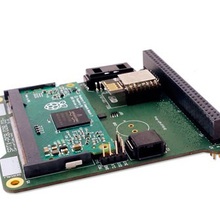
A Raspberry Pi Compute Module carrier board for satellite control, integrating ADCS sensors, an EM torquer driver and an onboard ADCS controller on a CAN bus architecture.
Typed specifications6 values
Discloses 2 of 13 fields engineers filter by in this category (category median 5).
- Mass
- 55 g product page
- Envelope (L×W×H)
- 86.2 × 93.6 × 14 mm product page
- Power consumption
- 0.25 W product page
- Design lifetime
- 1 years product page
- Lead time
- 2 months product page
- Random vibration
- 12 g RMS product page
Each value is typed with its unit and measurement condition and cites the datasheet page it was taken from. Nothing is guessed: a field that is absent here has not been published by the manufacturer. machine-extracted ✓ checked by NewSpace Market ✓ manufacturer confirmed by the manufacturer.
As published by the supplier16 lines, in the manufacturer's own wording
- Purpose
- Designed for satellite control. Provides satellite stabilization.
- Year of release
- 2017
- Design life
- 1 years
- Lead time
- 2 months
- Flight qualification of the product
- Yes
- Brief history of flight qualification
- In the composition of the satellites SiriusSat-1.2 (launched on 15.08.18.).
- Possibility to adapt the product to customer requirements
- No
- Dimensions (w/p pc104 connector)
- 86.2 × 93.6 × 14 mm
- Mass
- 55 g
- Supply voltage
- 5..14 V
- Power consumption, max (sensors only)
- 0.25 W
- Data interface
- CAN2.0B
- Operating temperature range
- -40...+85 °C
- Storage temperature range
- -50..+105 °C
- Mechanical vibration
- 12 g
- Mechanical shock
- 50 g
About
The Motherboard is designed for satellite control and provides satellite stabilization. It represents a Raspberry-Pi Compute Module carrier board that contains a set of devices interconnected via a flat and flexible CAN bus architecture. It features a slot for Raspberry Compute Module CM1/CM3, sensors on the CAN bus (magnetometer, angular velocity, temperature, voltages and currents), an EM torquer driver, an onboard ADCS controller, a low-power board managing MCU with B-DOT algorithm and flight plan capability, bootloaders with in-flight flash update ability, and a rich centralized satellite debug system. It was released in 2017, has a guaranteed service life of 1 year, and an estimated production/delivery time of 2 months. The product cannot be adapted to customer requirements. It has flight heritage as part of the SiriusSat-1 and SiriusSat-2 satellites, launched on 15.08.2018.
Documentation
No public datasheet yet — request the datasheet / ICD from the supplier.