NEA® Payload Release Module PRM 9103A
 Ensign-Bickford Aerospace & Defense (EBAD)
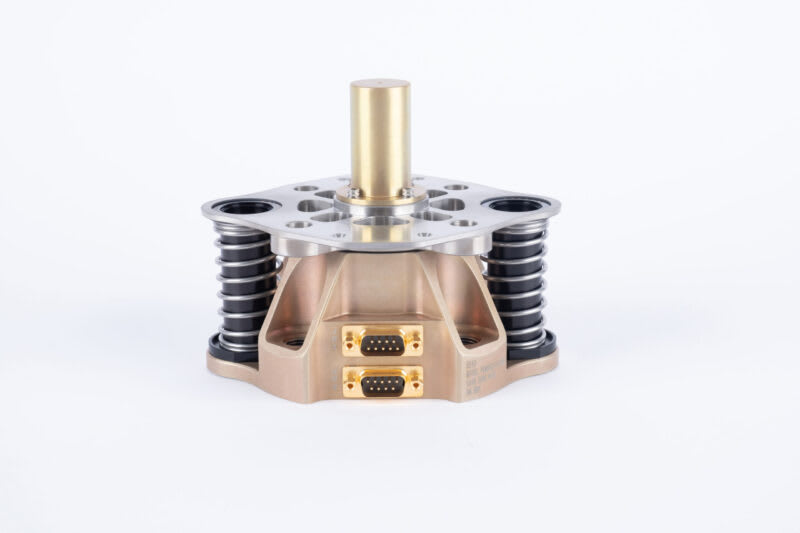
The PRM 9103A is an ultra-low shock, electrically initiated, single-shot, and factory refurbishable release mechanism designed to carry a high tensile preload until commanded to release, ideal for multi-point satellite release.
Typed specifications3 values
Discloses 2 of 10 fields engineers filter by in this category (category median 2).
- Release time
- 50 ms max · product page
- Release shock
- 500 g max · product page
- Operating temperature
- -90 °C product page
Each value is typed with its unit and measurement condition and cites the datasheet page it was taken from. Nothing is guessed: a field that is absent here has not been published by the manufacturer. machine-extracted ✓ checked by NewSpace Market ✓ manufacturer confirmed by the manufacturer.
As published by the supplier11 lines, in the manufacturer's own wording
- Axial preload
- Up to 15,000 lbf
- Axial stiffness
- 9.28 E+5 lbf/in
- Shear stiffness
- 5.98 E+6 lbf/in
- Bending stiffness
- 2.38 E+6 in-lbf/rad
- Shock output
- <500 g’s
- Actuation current
- 6 Amps for 15 ms
- Release time
- <50 ms
- Total mass
- 6.5 lbm
- Flyaway mass
- 1.8 lbm
- Operating temperature
- -90°C to +135°C
- Total spring energy per prm (configurable)
- 2.82 to 20.6 Joules
About
The NEA® Payload Release Module (PRM) 9103A is an ultra-low shock, electrically initiated, single-shot, and factory refurbishable release mechanism. It is designed to carry a high tensile preload until commanded to release. The preload is applied through a release rod held in place by two separable spool halves, which are held together by a tight winding of restraining wire. This wire is secured by redundant electrical fuse wires, ensuring maximum reliability as actuation of either circuit allows release. When sufficient electrical current is applied, the restraint wire unwinds, allowing the spool halves to separate and release the rod and associated preload. Tunable separation springs provide the push-off force for required separation velocity. The PRM 9103A can hold either a telemetry separation switch or a 37-pin separation connector for verifying spacecraft separation, ground power delivery, or communications. It features ultra-low release shock, redundant actuation, compatibility with standard launch vehicle firing circuitry, a launch vehicle to payload connector interface, non-explosive hold-down & release function, no debris generation, high simultaneity of multiple hold-down points, customizable separation velocity, and a wide operating temperature range. It is qualified to standard launch environments and factory refurbishment is available. It has more than 25 years of flight heritage as an NEA® HDRM.
Documentation
No public datasheet yet — request the datasheet / ICD from the supplier.