Reaction Wheel RW1
 EXA (Astro-und Feinwerktechnik)
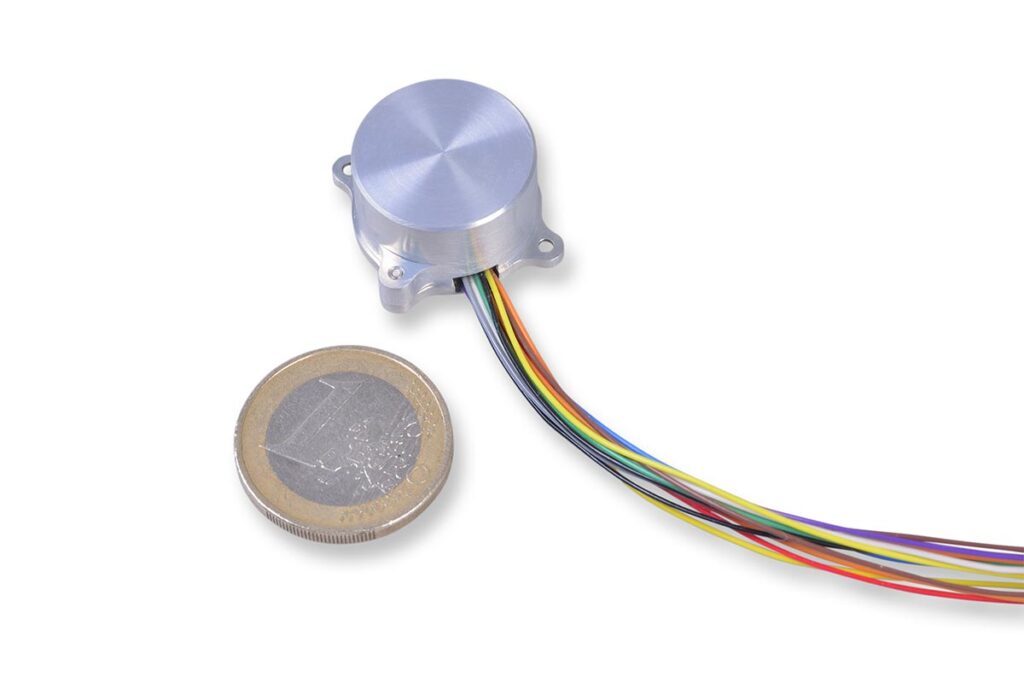
The RW1 is a reaction wheel designed for small satellites, featuring separate wheel drive electronics and available with two different rotating masses (Type A or Type B) to provide precise attitude control.
Typed specifications29 values
Discloses 5 of 10 fields engineers filter by in this category (category median 5).
- Mass
- 24 g max · datasheet p.1 24 g max · RW1 Type A, wheel mass | 12 g max · RW1 Type B, wheel mass
- Envelope (L×W×H)
- 21mm*21mm*12 mm datasheet p.1 21mm*21mm*12mm RW1 Type A | 21mm*21mm*12mm RW1 Type B
- Angular momentum storage
- 0.001 N·m·s @8000rpm · datasheet p.1 0.001 N·m·s RW1 Type A, @8000rpm | 0 N·m·s RW1 Type B, @8000rpm
- Max torque
- 0.023 mN·m Nominal · datasheet p.1 23 mN·m nom.
- Speed range
- 8 000 rpm Nominal · datasheet p.1 16 380 rpm Maximum | 16 380 rpm max · RW1 Type A, maximum rotation speed | 16 380 rpm max · RW1 Type B, maximum rotation speed | 8 000–16 380 rpm +1
- Supply voltage
- 5 V as published, mode unspecified · vendor page (catalogue a
- Power consumption
- 0.25 W as published, mode unspecified · vendor page (catalogue a
- Operating temperature
- -20 °C min · datasheet p.1 50 °C max
- Design lifetime
- 1 years datasheet p.1 1 years RW1 Type A, lifetime hardware, printed 1 | 1 years RW1 Type B, lifetime hardware, printed 1
- Satellite class
- CubeSat CubeSat Line · datasheet p.1
- Continuous (nominal) torque
- 0.023 mN·m RW1 Type A, nominal torque, printed 23*10^-6 Nm · datasheet p.1 0.004 mN·m RW1 Type B, nominal torque, printed 4*10^-6 Nm
- Nominal operating speed
- 8 000 rpm RW1 Type A, nominal rotation speed · datasheet p.1 8 000 rpm RW1 Type B, nominal rotation speed
Each value is typed with its unit and measurement condition and cites the datasheet page it was taken from. Nothing is guessed: a field that is absent here has not been published by the manufacturer. machine-extracted ✓ checked by NewSpace Market ✓ manufacturer confirmed by the manufacturer.
As published by the supplier30 lines, in the manufacturer's own wording
- Parameter
- Type A
- Angular momentum
- 5.8 E-4 Nms
- Nominal rotation speed
- 8000 rpm
- Maximum rotation speed
- ≈ 16 380 rpm
- Speed resolution
- 0.25 rpm (1LSB)
- Nomial torque (max. commandable)
- 23 E-6Nm
- Torque deviation – rms value
- <2.2 E-6Nm
- Supply voltage
- 5 V
- Power consumption for wde1 (stand by, motor off, pwde) wde for 1 wheel
- < 250 mW
- Power consumption for wde1 (stand by, motor off, pwde) wde for 3 wheels
- < 350 mW
- Power consumption for wde1 (stand by, motor off, pwde) wde for 4 wheels
- < 500 mW
- Maintaining nominal rotation speed1,2
- < 275 mW + PWDE
- Maximum consumption1,2
- < 375 mW + PWDE
- Mass (including 40 cm cable)
- ≤ 24 g
- Wde mass
- ≤ 45 g
- Moment of inertia
- 694.5 E-9 kg m2
- Dimension single wheel
- 21 x 12 x 21 mm3
- Temperature operation
- -20 °C to +50 °C
- Temperature non-operation
- -40 °C to +65 °C
- Design lifetime
- 1 year in LEO
- Storage time
- 2 years including 250h of ground operation
- Parameter (typ)
- Type B
- Angular momentum (2)
- 1.0 E-4 Nms
- Nomial torque (max. commandable) (2)
- 4 E-6Nm
- Torque deviation – rms value (2)
- 0.8 E-6Nm
- Maintaining nominal rotation speed1,2 (2)
- < 200 mW + PWDE
- Maximum consumption1,2 (2)
- < 300 mW + PWDE
- Mass (including 40 cm cable) (2)
- ≤ 15 g
- Moment of inertia (2)
- 119.5 E-9 kg m2
- Dimension single wheel (2)
- 21 x 12 x 21 mm3
About
The Reaction Wheel RW1 is a compact and efficient solution for attitude control in small satellites. It is characterized by its separate wheel drive electronics (WDE) which can manage up to four reaction wheels. The system incorporates a PI controller for precise speed and acceleration management. Users can choose between two different rotating masses, Type A or Type B, to meet specific mission requirements. The RW1 offers four standard data interfaces for versatile integration. Its mechanical design, coupled with high levels of alignment and balancing, ensures low levels of emitted vibrations, crucial for sensitive satellite operations. The product is designed for a 1-year lifetime in Low Earth Orbit (LEO) and has a storage time of 2 years, including 250 hours of ground operation.
Documentation
Need the full ICD, test reports or a specific revision? Ask the supplier directly.