Reaction Wheel RW3000
 EXA (Astro-und Feinwerktechnik)
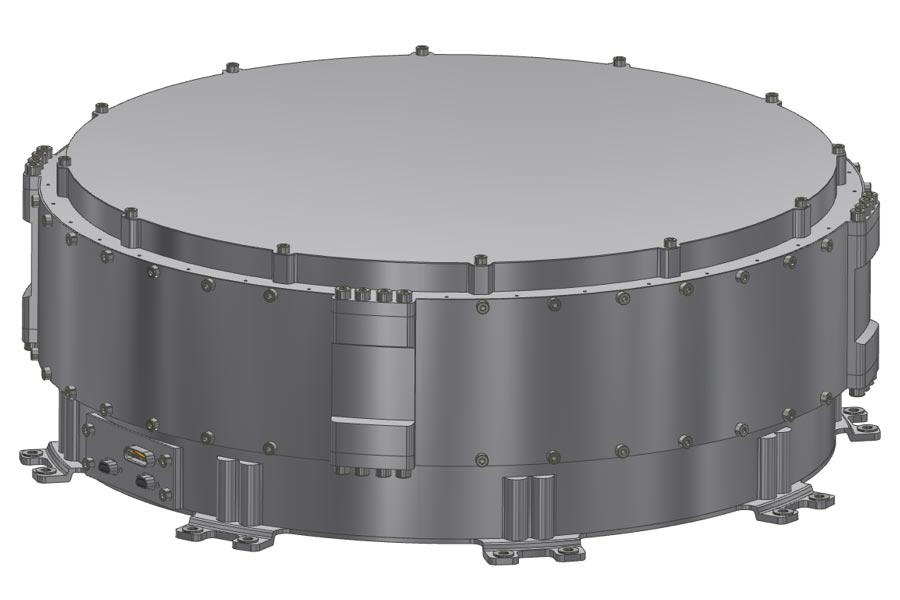
The RW3000 is a reaction wheel designed for satellite attitude control, currently under development. It offers an angular momentum of 50 Nms and a nominal reaction torque of 0.2 Nm.
Typed specifications21 values
Discloses 6 of 10 fields engineers filter by in this category (category median 5).
- Mass
- 9 000 g as published, mode unspecified · vendor page (catalogue a 9 000 g max
- Envelope (L×W×H)
- 370mm*370mm*120mm datasheet p.1
- Angular momentum storage
- 50 N·m·s @4000rpm · datasheet p.1 50 N·m·s 4000rpm
- Max torque
- 200 mN·m Nominal Torque · datasheet p.1
- Speed range
- 4 000 rpm Nominal Rotation Speed · datasheet p.1
- Supply voltage
- 22–37 V as published, mode unspecified · vendor page (catalogue a
- Power consumption
- 2.5 W as published, mode unspecified · vendor page (catalogue a
- Operating temperature
- -20 °C min · datasheet p.1 60 °C max | -20–60 °C
- Design lifetime
- 15 years datasheet p.1 15.5 years as published, mode unspecified
- Wheels in the unit
- 1 datasheet p.0
- Survival temperature
- -40 °C product page
- Satellite class
- large >500 kg datasheet p.0 smallsat 100-500 kg
- Continuous (nominal) torque
- 200 mN·m printed 0.2 Nm · datasheet p.1
- Nominal operating speed
- 4 000 rpm datasheet p.1
- Flywheel moment of inertia
- 0.119 kg·m² datasheet p.1
Each value is typed with its unit and measurement condition and cites the datasheet page it was taken from. Nothing is guessed: a field that is absent here has not been published by the manufacturer. machine-extracted ✓ checked by NewSpace Market ✓ manufacturer confirmed by the manufacturer.
As published by the supplier17 lines, in the manufacturer's own wording
- Angular momentum
- 50.0 Nms @ nominal speed
- Nominal rotation speed
- 4000 rpm
- Nomial reaction torque
- 0.2 Nm Max. commandable reaction torque
- Supply voltage
- 22 to 37 V
- Power consumption
- ≤ 2.5 W Stand by (motor off)
- Power consumption (max)
- ≤ 30.0 W @ nominal speed 0.1 Nm/max speed
- Power consumption (max) (max)
- ≤ 75 W Maximum (0.2 Nm/max. speed)
- Power consumption (max) (max)
- ≤ 140 W Maximum (0.2 Nm/max. speed)
- Mass
- ≤ 9.0 kg
- Moment of inertia
- 1.19e-1 kg m2 Rotating mass
- Dimensions
- 370 x 370 x 120 mm3
- Operation
- -20 °C to +60 °C
- Start-up
- -30 °C to +60 °C
- Survival temperature
- -40 °C to +65 °C
- Data interface
- CAN/RS485
- Design lifetime
- > 15.5 years
- Storage time
- > 6 years including 1500h of ground operation
About
The RW3000 is a reaction wheel specifically developed for use in satellites to provide precise attitude control. This product is currently under development. It features an angular momentum of 50.0 Nms at its nominal speed of 4000 rpm and can deliver a maximum commandable reaction torque of 0.2 Nm. The device operates with a supply voltage ranging from 22 to 37 V. Power consumption varies depending on the operational state: ≤ 2.5 W in standby (motor off), ≤ 30.0 W at nominal speed with 0.1 Nm, ≤ 75 W at maximum speed, and ≤ 140 W at maximum (0.2 Nm/max. speed). Mechanically, the RW3000 has a mass of ≤ 9.0 kg and dimensions of 370 x 370 x 120 mm³. Its moment of inertia for the rotating mass is 1.19e-1 kg m². The reaction wheel is designed to operate within a temperature range of -20 °C to +60 °C, with a start-up capability from -30 °C to +60 °C, and a survival temperature range of -40 °C to +65 °C. Data communication is handled via CAN/RS485 interfaces. The design lifetime is specified as > 15.5 years, with a storage time of > 6 years, which includes 1500 hours of ground operation.
Documentation
Need the full ICD, test reports or a specific revision? Ask the supplier directly.