Q7 Computer-on-Module
 Xiphos Technologies
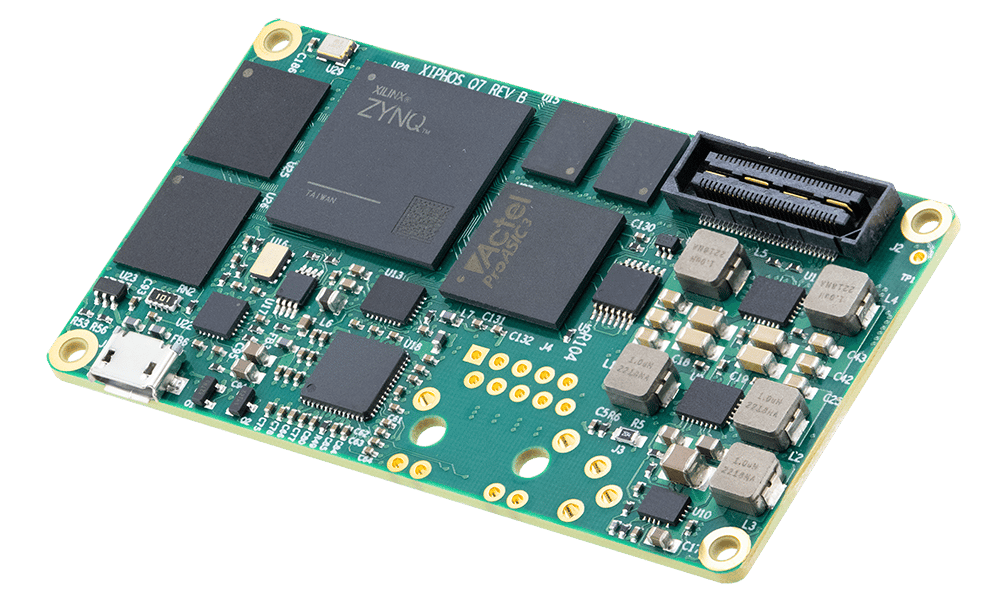
Ultra-low SWaP Zynq-based processor card for embedding in custom satellite payloads and bus subsystems.
Key figurescomparable across the catalogue
- Power
- 2 W
Normalised to common units so this product can be compared with others in its category. The supplier's own wording is below.
As published by the supplier
- Processor
- Xilinx Zynq SoC
- CPU
- Dual-core ARM Cortex-A9 MPCore
- Logic
- Programmable FPGA fabric
- RAM
- LPDDR2 with ECC
- Flash
- 2x QSPI Flash (NOR)
- Storage
- 2x MicroSD
- Interfaces
- Gigabit Ethernet, USB 2.0, serial, 90 I/O via mezzanine connector
- Power (Typical)
- 2 W
- Input Voltage
- 5 to 28 V
- Operating System
- Linux SDK
- Radiation Tolerance (TID)
- 25 krad (Si)
About
The Xiphos Q7 is an ultra-low SWaP computer-on-module built around the Xilinx Zynq SoC, combining a dual-core ARM Cortex-A9 MPCore with reprogrammable FPGA logic. It maintains a small form factor, minimal weight, and conservative power usage while delivering solid multiprocessor CPU performance, making it ideal for embedding directly into custom satellite payloads or bus subsystems.
The Q7 is well-suited for applications requiring high processing power and flexibility in a power-constrained environment, including satellite imaging, visual inspection, autonomous navigation, image processing, signal processing, and attitude control. Its hybrid CPU+FPGA architecture allows real-time control tasks and compute-intensive workloads to execute simultaneously on separate processing elements.
Xiphos provides a Linux SDK along with a Vivado skeleton project, enabling customers to begin development immediately. The Q7 includes a radiation effects mitigation suite and has been tested to 25 krad TID, making it suitable for LEO, lunar, and cis-lunar space science missions as well as launch vehicle avionics.
Documentation
Need the full ICD, test reports or a specific revision? Ask the supplier directly.