Q8 On-Board Computer
 Xiphos Technologies
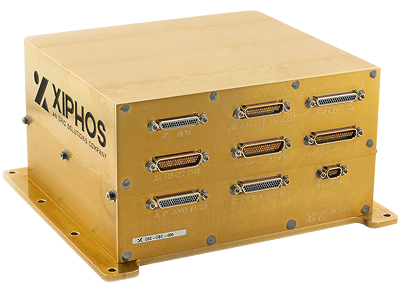
Flight-proven SmallSat on-board computer based on the Q8 processor, providing full spacecraft control with 120+ years of flight heritage.
Typed specifications66 values
Discloses 9 of 13 fields engineers filter by in this category (category median 5).
- Processor
- AMD/Xilinx UltraScale+ MPSoC processor datasheet p.1
- Mass
- 957 g typ. · datasheet p.2 957 g
- Envelope (L×W×H)
- 167.3 mm x 182.6 mm x 91 mm datasheet p.2 167.3 mm x 182.6 mm x 91 mm includes 10x M4 mounting holes
- Mass storage
- 2 GB product page
- Operating system
- Linux datasheet p.1 Linux Linux Operating System environment, Xilinx toolchain
- Supply voltage
- 9 V nom. · datasheet p.2 9 V nom. · input voltage, J9 power connector
- Power consumption
- 7.5 W nominal · datasheet p.2 14 W peak | 14 W max · peak | 7.5 W nom.
- Data interface
- RS-422 datasheet p.1 GPIO 10x 3.3 V outputs, 10x 3.3 V inputs | RS-485 18x RS422/485/232 ports | RS-422 18x RS422/485/232 ports, 2x full duplex only, 7x RS422 OUT po… | Ethernet 1x GigE (1Gbps) port with magnetics +18
- Operating temperature
- -40–60 °C datasheet p.2 -40–60 °C derated
- Radiation tolerance (TID)
- 30 krad datasheet p.1 30 krad 30krad TID for long-duration missions
- TRL
- 9 TRL9 product · datasheet p.1
- Board format
- custom datasheet p.2
- Radiation and fault mitigation
- EDAC / ECC on RAM EDAC-protected RAM · datasheet p.1 FPGA bitstream scrubbing FPGA bit-stream scrubbing | latch-up protection (current limiting) overcurrent protection (multiple) | software watchdog software robustness / watchdog | TMR in FPGA triple mode redundancy in Control FPGA +6
- Connector
- Micro-D: J1/J2/J3/J4/J7 51 pins, J5/J6 37 pins, J8 31 pins, J9 9 socket (power) datasheet p.2
- Flight heritage
- TRL9 product built around the Q8 processor board, which has hundreds of years of flight heritage across over 100 missions. datasheet p.1 Xiphos has been flying Q-Cards since 2002.
- Satellite class
- microsat 10-100 kg ideally suited for MicroSat and SmallSat buses · datasheet p.1 smallsat 100-500 kg ideally suited for MicroSat and SmallSat buses
- Missions flown
- 100 datasheet p.1 100 min · hundreds of years of flight heritage across over 100 missions…
- FPGA
- Xilinx UltraScale+ MPSoC datasheet p.1
- GPIO lines
- 20 20x 3V3 GPIO (10 outputs + 10 inputs), J5 · datasheet p.2
- Data interface speed
- 1 000 Mbps GigE Ethernet port · datasheet p.2
- Analog inputs
- 12 9x analog inputs 0 to 5 V (10 mV accuracy) + 3x analog inputs… · datasheet p.2 48 PT2000 temperature sensor inputs
Each value is typed with its unit and measurement condition and cites the datasheet page it was taken from. Nothing is guessed: a field that is absent here has not been published by the manufacturer. machine-extracted ✓ checked by NewSpace Market ✓ manufacturer confirmed by the manufacturer.
As published by the supplier12 lines, in the manufacturer's own wording
- Processor
- Xilinx Zynq SoC (ARM dual-core Cortex-A9 MPCore)
- Control FPGA
- Microchip ProASIC3
- Ram
- 256 MB LPDDR2 (ECC)
- Storage
- 2x MicroSD
- Serial interfaces
- RS-422, RS-485, RS-232, CAN, LVDS-based protocols
- Ethernet
- Gigabit Ethernet
- USB
- USB 2.0
- Dimensions
- 167.3 x 182.6 x 91 mm
- Mass
- 957 g
- Power (Nominal)
- 7.5 W
- Power (Peak)
- 14 W
- Operating temperature
- -40 to +60 deg C
About
The Xiphos Q8 OBC is a complete on-board computer solution designed to meet the needs of demanding SmallSat missions, giving operators full control over all spacecraft subsystems. Built upon the proven Q8 processor board, it is backed by over 120 years of cumulative flight heritage across numerous missions and constellations.
The Q8 OBC philosophy centers on enabling the spacecraft platform design rather than constraining it. Customizable GPIO, LVDS pins, and flexible serial interface configurations allow integration with virtually any attitude control, power management, payload, or communication subsystem. The Microchip ProASIC3 supervisory FPGA handles configuration management and fault protection independently of the main processor.
The board provides a rich set of interfaces for satellite bus applications, including RS-422/485/232, CAN, LVDS-based protocols, Gigabit Ethernet, and USB 2.0. Analog inputs and PT2000 thermistor inputs enable distributed thermal monitoring across the spacecraft.
Documentation
Need the full ICD, test reports or a specific revision? Ask the supplier directly.