Q9 Versal Computer-on-Module
 Xiphos Technologies
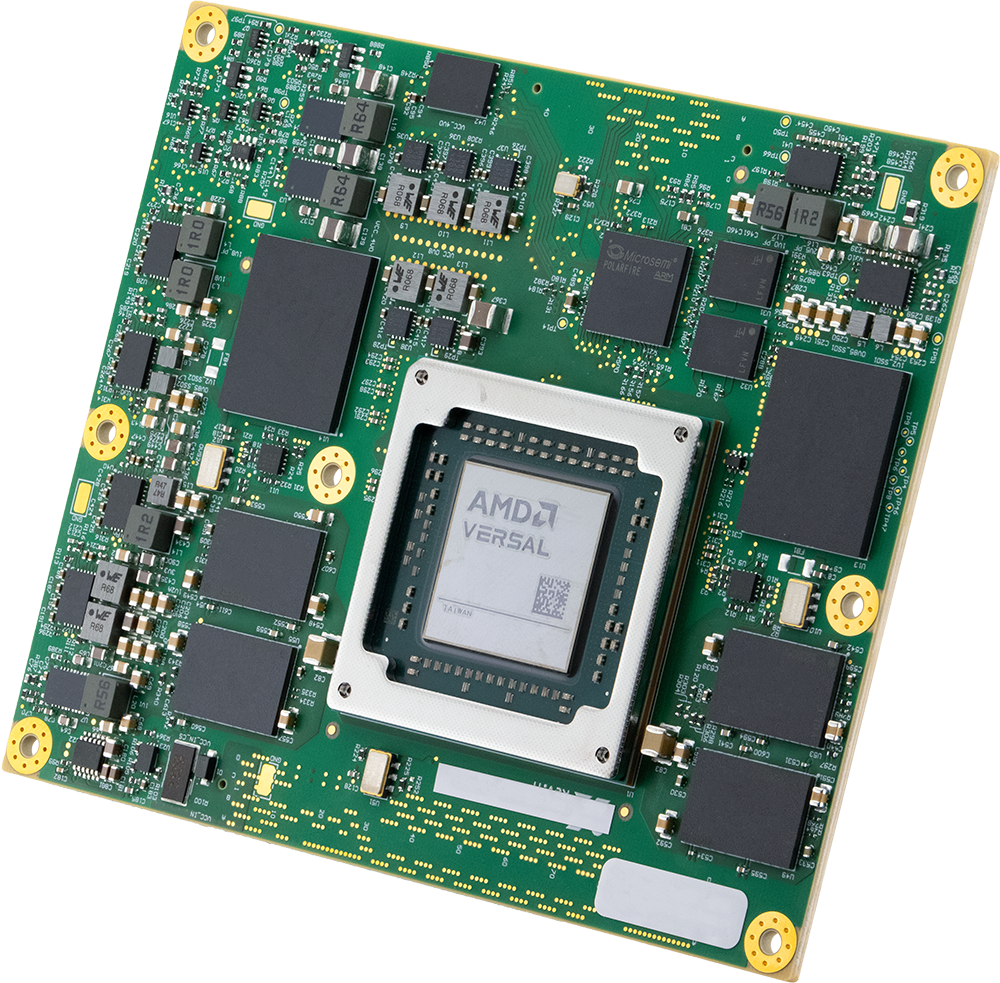
High-performance AMD Versal AI-edge compute module with 152 AI Engine tiles, 2 TB NVMe storage, and 30-50 W power budget for satellite AI/ML payloads.
Typed specifications76 values
Discloses 10 of 13 fields engineers filter by in this category (category median 5).
- Processor
- AMD Versal AI Core Adaptive System-on-Chip datasheet p.3 Dual core ARM Cortex A72 Application Processing Unit | Dual core ARM Cortex R5F Real-Time Processing Unit
- Mass
- 154 g without connectors · datasheet p.3
- CPU clock
- 750 MHz Real-Time Processing Unit · datasheet p.3 1 700 MHz max · Application Processing Unit | 1 700 MHz max · ARM Cortex A72 APU | 750 MHz max · ARM Cortex R5F RPU
- Envelope (L×W×H)
- 90 mm x 110 mm x 20 mm datasheet p.2
- RAM
- 16 GB LPDDR4 DRAM datasheet p.3 16 384 MB LPDDR4 DRAM, PS and PL-accessible (2x8 GB) | 1GB (4x 256 MB) QSPI Flash (NOR) | 1MB MRAM
- Mass storage
- 2x SSD, 1,000 GB each datasheet p.3 1 000 GB 2x SSD, 1,000 GB each, on independent buses | 2 048 GB access to 2TB of high speed data storage
- Operating system
- Yocto Linux BSP (LTS distribution) datasheet p.3 Linux Yocto Linux BSP (LTS distribution)
- Supply voltage
- 8–14 V datasheet p.3
- Power consumption
- 30 W typical · datasheet p.3 30 W typ. | 30–50 W typical | 30–50 W nom. · typical | 50 W typical +1
- Data interface
- GPIO datasheet p.2 GPIO 64 LVDS/Single Ended GPIO, 20 GPIO 1.8 V, 40 GPIO 3.3 V, 49 MIO | CAN CAN via MIO | Ethernet Gigabit interfaces via MIO; 10 GbE via GTYP; 2 Multi-rate MACs | other JESD204B +14
- Operating temperature
- -40–60 °C datasheet p.3 -40–60 °C operating
- Processor architecture
- ARM Cortex-A dual core ARM Cortex A72 APU · datasheet p.3 ARM Cortex-R dual core ARM Cortex R5F RPU
- Board format
- custom datasheet p.2
- Flight software support
- Application Development Kit with standard Linux libraries for C/C++; standard Linux and Xilinx kernel drivers; Vivado and Vitis AI datasheet p.2
- Radiation and fault mitigation
- EDAC / ECC on RAM EDAC-protected RAM · datasheet p.3 FPGA bitstream scrubbing FPGA bit-stream scrubbing | latch-up protection (current limiting) Over-current protection (multiple) | software watchdog Software robustness / watchdog | TMR in FPGA Triple mode redundancy in Control FPGA (Q9S flight models) +6
- Connector
- 2 mezzanine connectors datasheet p.3
- Missions flown
- 260 datasheet p.4
- Cores
- 2 ARM Cortex A72 Application Processing Unit · datasheet p.3 2 ARM Cortex R5F Real-Time Processing Unit
- FPGA
- AMD Versal AI Core Adaptive SoC: 820,000 system logic cells, 750,000 flip flops, 375,000 lookup tables, 984 DSP slices, 152 AI Engine-ML tiles; Control FPGA Microchip PolarFire datasheet p.3
- GPIO lines
- 20 GPIO 1.8 V · datasheet p.2 40 GPIO 3.3 V | 64 LVDS/Single Ended GPIO
- AI performance
- 101 TOPS 101 TOPS and 8 TFLOPs of AI/ML performance · datasheet p.3
- RAM type
- LPDDR4 datasheet p.3 MRAM 1MB MRAM for critical telemetry/state data
- Program / boot memory
- 1 MB MRAM for critical telemetry/state data · datasheet p.3 1 MB QSPI Flash (NOR), 4x 256 MB
- Data interface speed
- 26 562.5 Mbps GTY transceivers · datasheet p.3
- Analog inputs
- 4 datasheet p.2
Each value is typed with its unit and measurement condition and cites the datasheet page it was taken from. Nothing is guessed: a field that is absent here has not been published by the manufacturer. machine-extracted ✓ checked by NewSpace Market ✓ manufacturer confirmed by the manufacturer.
As published by the supplier19 lines, in the manufacturer's own wording
- Mpsoc
- AMD Versal SoC
- Application cpu
- Dual-core ARM Cortex-A72 @ 1.7 GHz
- Real-time cpu
- Dual-core ARM Cortex-R5F @ 750 MHz
- Ai engines
- 152 AI Engine-ML tiles
- System logic cells
- 820,000
- Dsp slices
- 984
- Ps lpddr4 ram
- 8 GB
- Pl lpddr4 ram
- 8 GB
- Qspi flash (NOR)
- 1 GB
- Nvme SSD
- 2x 1,000 GB (independent buses)
- Mram
- 1 MB
- Gty transceivers
- 26.5625 Gbps (PCIe Gen 4, Ethernet, JESD204B)
- Control FPGA
- Microchip PolarFire
- Dimensions
- 90 x 110 x 20 mm
- Mass
- 56 g (without connectors)
- Power (Typical)
- 30 to 50 W
- Supply voltage
- 8 to 14 V DC
- Operating temperature
- -40 to +60 deg C
- Operating system
- Yocto Linux BSP (LTS)
About
The Xiphos Q9 is a high-performance AI and edge-processing system-on-board built around the AMD Versal SoC, representing the first time a Versal-based platform has been available in such a small form factor. The Q9 extends the Xiphos Q-Card lineup to mission profiles demanding 30-50W of processing capability, particularly real-time sensor processing using AI/ML technologies.
The AMD Versal device integrates 152 AI Engine-ML tiles alongside dual-core ARM Cortex-A72 application processors at 1.7 GHz, dual-core Cortex-R5F real-time processors at 750 MHz, and 820,000 system logic cells with 984 DSP slices. This heterogeneous compute architecture allows simultaneous execution of control tasks, FPGA signal processing, and neural network inference workloads without the inter-chip latency of discrete AI accelerator solutions.
The Q9 includes 16 GB of LPDDR4 DRAM across two independent PS- and PL-accessible interfaces, 1 GB of QSPI NOR flash, and two independent 1 TB NVMe SSDs for high-speed mass memory. High-speed JESD204B, PCIe Gen 4, and 100G Ethernet connectivity via 26.5625 Gbps GTY transceivers enable direct connection to high-bandwidth sensors, RF front-ends, and downlink transmitters.
Documentation
Need the full ICD, test reports or a specific revision? Ask the supplier directly.