Geostationary Telecommunication Satellite
 Yuzhnoye Design Bureau
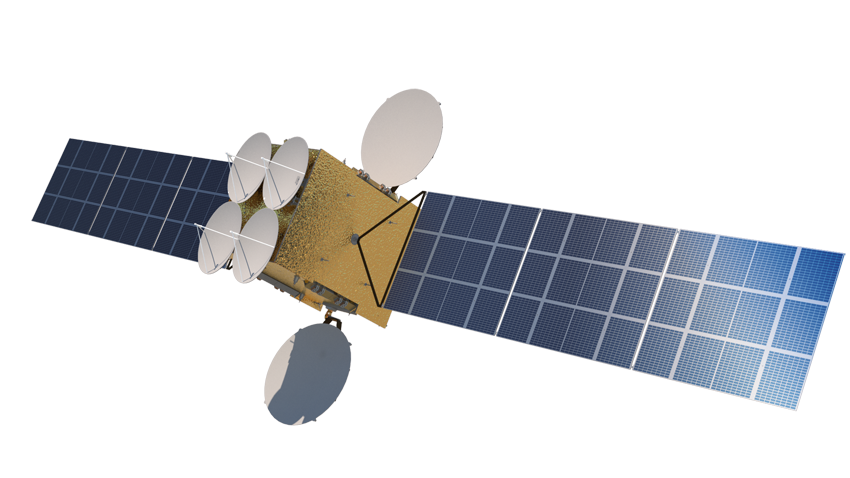
The Geostationary Telecommunication Satellite developed by Yuzhnoye SDO provides comprehensive communications services from geostationary orbit at 35,786 km altitude, including fixed communication services such as high-speed channels, VSAT data networks, and Internet access; TV broadcasting services including video, voice communications, DTH signal distribution, and HDTV; as well as multimedia services. Compatible launch vehicles include Yuzhnoye-developed […]
Key figurescomparable across the catalogue
- Mass
- 4,920 kg
- Payload capacity
- 350 kg
- Power
- 6,000 W
- Design life
- 15 years
Normalised to common units so this product can be compared with others in its category. The supplier's own wording is below.
As published by the supplier
- Satellite mass (lift-off)
- 4,920 kg
- Payload mass
- 350 kg
- Orbital type
- Geostationary
- Orbital altitude
- 35,786 km
- Orbital inclination
- 0 deg
- Revolution period
- 1,436.07 min
- Position-keeping accuracy
- +/-0.1 deg latitude/longitude
- Attitude control
- 3-axis active
- Attitude sensors
- Astromeasuring system, angular velocity meters
- Attitude actuators
- Reaction wheels, electrojet engines
- Orientation accuracy
- 0.01 deg or less
- Uplink frequency
- 13,240 to 13,250 MHz
- Downlink frequency
- 10,945 to 10,950 MHz
- Power supply (daily average)
- 7,200 W minimum
- Payload power allocation
- 6,000 W minimum
- Design lifespan
- 15 years
About
The Geostationary Telecommunication Satellite developed by Yuzhnoye SDO provides comprehensive communications services from geostationary orbit at 35,786 km altitude, including fixed communication services such as high-speed channels, VSAT data networks, and Internet access; TV broadcasting services including video, voice communications, DTH signal distribution, and HDTV; as well as multimedia services. Compatible launch vehicles include Yuzhnoye-developed systems plus Falcon 9, CZ-3B, Ariane 5, Ariane 6, and H-IIA. The satellite lifts off at 4,920 kg carrying 350 kg of payload with a minimum power supply of 7,200 W daily average (6,000 W allocated to payload). Three-axis active attitude control using an astromeasuring system, reaction wheels, and electrojet (ion) engines achieves plus or minus 0.01 degree pointing accuracy over a 15-year design lifespan.
Documentation
No public datasheet yet — request the datasheet / ICD from the supplier.