GS-1 Nanosatellite
 Yuzhnoye Design Bureau
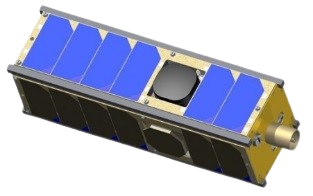
The GS-1 is a CubeSat-class nanosatellite developed by Yuzhnoye SDO, designed primarily to verify in the space environment the adopted fundamental engineering solutions to a novel green monopropellant thruster and test new technologies, components, materials, and software intended for prospective spacecraft missions. Measuring 111x110x370 mm and with a bus mass of 2,987 grams plus 1,000 […]
Key figurescomparable across the catalogue
- Mass
- 2.99 kg
- Largest dimension
- 370 mm
- Total impulse
- 320 N·s
Normalised to common units so this product can be compared with others in its category. The supplier's own wording is below.
As published by the supplier
- Dimensions
- 111 x 110 x 370 mm
- Bus mass
- 2,987 g
- Propulsion unit mass
- 1,000 g
- Orbit type
- Near-circular
- Orbital altitude
- 350 to 800 km
- Orbital inclination
- 48 to 98 deg
- Propulsion type
- Green monopropellant
- Total burn capacity
- 320 N*s
- Attitude accuracy
- +/-10 deg
- Active lifetime
- more than 1 year
About
The GS-1 is a CubeSat-class nanosatellite developed by Yuzhnoye SDO, designed primarily to verify in the space environment the adopted fundamental engineering solutions to a novel green monopropellant thruster and test new technologies, components, materials, and software intended for prospective spacecraft missions. Measuring 111x110x370 mm and with a bus mass of 2,987 grams plus 1,000 grams for the propulsion unit, it operates in near-circular orbits at 350 to 800 km altitude with inclinations of 48 to 98 degrees. The satellite employs an environmental (green) monopropellant propulsion unit delivering a total burn capacity of 320 N·s. Attitude control achieves plus or minus 10 degree accuracy. The GS-1 technology demonstrator paves the way for the next generation of Yuzhnoye-developed microsatellite missions.
Documentation
No public datasheet yet — request the datasheet / ICD from the supplier.