Mayak-SH-7
 Yuzhnoye Design Bureau
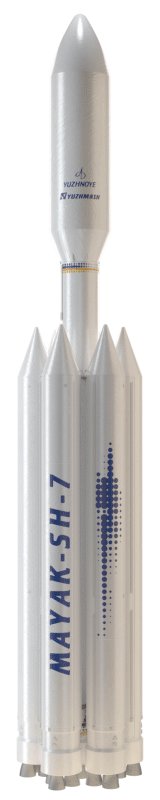
The Mayak-SH-7 is the largest variant in Yuzhnoye SDO’s Mayak super heavy-lift launch vehicle family, capable of delivering 133 tonnes to low Earth orbit and 40 tonnes on a lunar trajectory. It employs eighteen RD815 booster engines combined with three core first-stage engines, all burning liquid oxygen and kerosene. The second stage uses the RD872 […]
Key figurescomparable across the catalogue
- Payload capacity
- 40,000 kg
Normalised to common units so this product can be compared with others in its category. The supplier's own wording is below.
As published by the supplier
- Vehicle class
- Super heavy-lift
- Number of stages
- 2
- Height
- 79,900 mm
- Body diameter
- 3,900 mm
- Fairing diameter
- 6,200 mm
- Gross mass (no payload)
- 3,001 t
- Stage 1 propellant
- LOX + kerosene
- Stage 2 propellant
- LOX + kerosene
- Booster engines
- 18 x RD815
- Stage 1 engines
- 3 x RD815
- Stage 2 engine
- RD872
- Stage 1 thrust (sea level)
- 5,277.72 tf
- Stage 2 thrust (vacuum)
- 93 tf
- Payload to LEO (200 km, 51.6 deg)
- 133 t
- Payload to lunar trajectory (with booster)
- 40 t
About
The Mayak-SH-7 is the largest variant in Yuzhnoye SDO’s Mayak super heavy-lift launch vehicle family, capable of delivering 133 tonnes to low Earth orbit and 40 tonnes on a lunar trajectory. It employs eighteen RD815 booster engines combined with three core first-stage engines, all burning liquid oxygen and kerosene. The second stage uses the RD872 vacuum engine. At nearly 80 meters tall with a 6.2-meter fairing, the Mayak-SH-7 is designed for the most demanding national and commercial large-payload missions, including crewed lunar exploration support. Its clustered engine architecture enables massive combined thrust of 5,277.72 tf at sea level while leveraging proven Ukrainian rocket engine technology from the Zenit heritage.
Documentation
No public datasheet yet — request the datasheet / ICD from the supplier.